2 min read
AI budgets stall when IT and business leaders optimize for different things. Here's the fix.
Marina Uchoa
:
May 15, 2026 6:23:04 PM
If you've looked at an AI budget template and still haven't moved forward, the problem probably isn't the numbers — it's that IT and the business are solving for different things.
Most AI budgeting conversations fail before they start. IT asks about architecture and security. Business leaders ask about win rates and client impact. Both are right. Neither is speaking the other's language. And without a shared framework, decisions stall, pilots get duplicated, and shadow AI projects quietly multiply.
If that sounds familiar, here are four things you can act on now.
1. Ask the questions that expose the real gap
Before you open a spreadsheet, get IT and business leaders in the same room and surface where they actually disagree. These three questions tend to crack it open fast:
- What does success look like in 6 months — and how do we measure it?
- Which costs belong to this project, and which belong to the shared platform?
- What would make this a clear "no" — and what signals tell us to double down?
If you can't agree on answers to these, the budget conversation will keep going in circles. Get alignment here first.
2. Translate costs into outcomes — every time
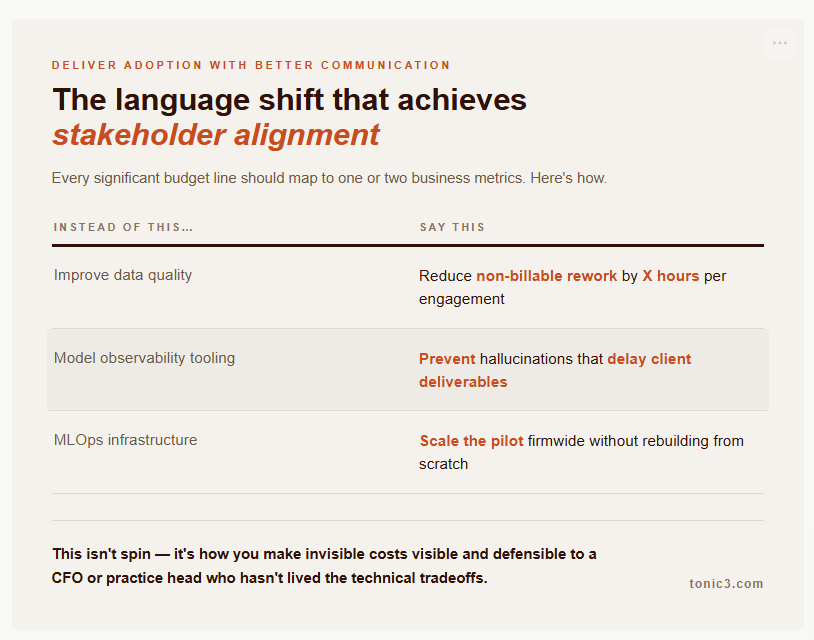
IT leaders often justify infrastructure spend in technical terms. Business leaders tune out. The fix is a consistent translation habit: every significant budget line gets mapped to one or two business metrics.
| Instead of this... | Say this |
|---|---|
| "Improve data quality" | "Reduce non-billable rework by X hours per engagement" |
| "Model observability tooling" | "Prevent hallucinations that delay client deliverables" |
| "MLOps infrastructure" | "Scale the pilot firmwide without rebuilding from scratch" |
This isn't spin — it's how you make invisible costs visible and defensible to a CFO or practice head who hasn't lived the technical tradeoffs.
3. Use budget swimlanes to stop the ownership debate
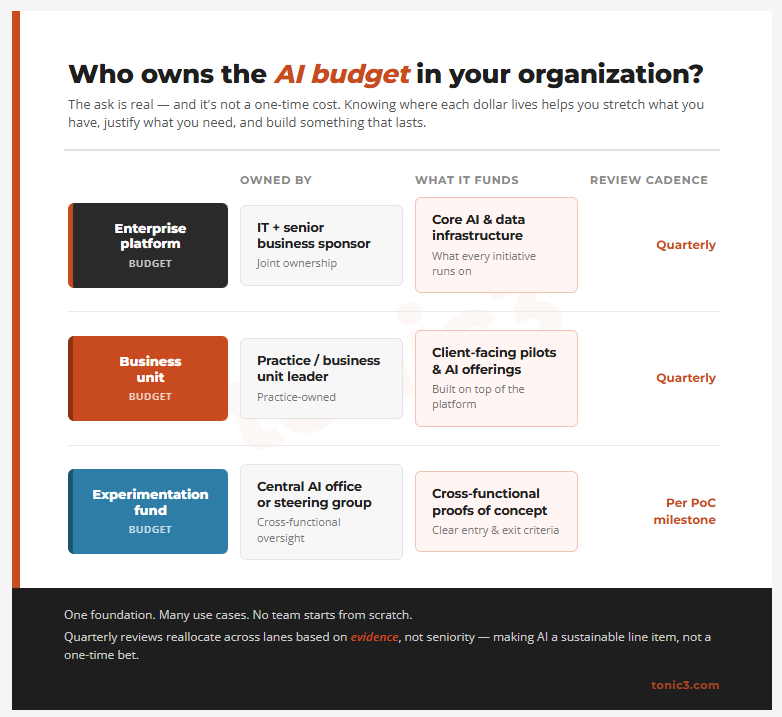
A recurring fight in professional services AI budgets: "Who pays for the shared platform?" The cleanest resolution is a three-swimlane structure that separates ownership by type of spend.

The diagram shows three swimlanes:
- Enterprise platform budget — owned jointly by IT + a senior business sponsor. Covers core AI and data infrastructure. Reviewed quarterly.
- Business unit budget — owned by the practice or business unit leader. Funds client-facing pilots and AI offerings built on top of the platform. Reviewed quarterly.
- Experimentation fund — governed by a central AI office or steering group. Funds cross-functional proofs of concept with clear entry and exit criteria. Reviewed per PoC milestone.
Quarterly reviews — not annual — let you reallocate across swimlanes based on evidence, not politics.
4. Break the full cost stack into three layers
Sticker shock and scope creep both come from incomplete cost visibility. Before any AI initiative gets approved, map it across all three layers:
-
Build Platform licensing, integration work, data preparation, and the initial project team. This is what most proposals include — but rarely all of it.
-
Run Cloud compute, model inference, monitoring, security, and compliance. Often missing from early-stage budgets. Almost always the source of surprise costs at scale.
-
People Central AI engineering, embedded product owners in practices, and any vendor or contractor support. Decide up front whether this is centralized or distributed — and put it in the budget either way.
Simple use cases land toward the low end of each layer. Multi-agent, cross-firm systems land at the high end. The framework keeps both honest.
Still working through the numbers?
If these questions are surfacing real gaps in how your firm is approaching AI investment, let's talk through them. Or join our next Learning Lab session — a working session built around exactly these budget and alignment challenges.
Need a place to discuss your questions? Join the next Learning Lab