
 Jim Croall
- Freelancers fit clear, one-off projects with a defined brief.
- Traditional agencies fit brand-defining strategic work like rebrands and major campaign launches.
- On-demand creative subscription platforms fit short-term volume spikes, but run on a shared bench across many clients.
- Adding headcount fits deep, long-term strategic work, but it's the slowest option to stand up and the hardest to flex.
- Embedded managed creative teams fit sustained, high-volume production without adding fixed headcount or losing brand continuity.
At some point, every in-house creative leader ends up in the same room, staring at the same whiteboard, weighing the same four options: hire a freelancer, call an agency, sign up for an on-demand creative platform, or ask for headcount. Usually there's a deadline attached, which means someone in the room is trying to sell you on one answer before you've had time to think through all four.
Strip away the deadline and it comes down to one question: are you buying time, or buying outcomes? Every option trades some fit (brand context, continuity) for value (speed, cost, scalable output), or the reverse. None of them is wrong. Each fits a specific kind of problem. It also helps to know why this decision keeps landing on your desk. Our CEO covers the four forces driving it in Drowning in Success: What's Generating Unexpected Demand for In-house Agencies. Below, we compare the four traditional options, add a fifth most teams overlook, and lay out three questions for choosing what fits the work in front of you.
Freelancers
A freelancer is an independent contractor engaged for a single, well-defined project.
Best for: a one-off project with a clear brief and no ongoing dependency.
The real limitation: nobody manages continuity. Every new freelancer starts from zero on your brand, your tone, and your approval process. That's fine once. Repeat it every month and it becomes its own management job (sourcing, briefing, re-explaining context) that quietly eats more time than it looks like on paper.
Traditional agencies
A traditional agency is a full-service outside firm typically engaged for strategic or campaign-level creative work.
Best for: big swings, like a rebrand, a major campaign launch, or work that needs deep strategic thinking from outside your building.
The real limitation: agencies are built for that kind of work, not the weekly grind of resizes, localizations, and asset variants. Give an agency high-volume production and you'll pay agency rates for execution that didn't need agency thinking, on an agency timeline that doesn't match how fast your queue moves.
On-demand creative subscription platforms
An on-demand creative subscription platform is a paid service, typically billed monthly, that gives you access to a rotating pool of creative talent for variable-volume design and production requests.
Best for: absorbing a volume spike, or covering a format your team doesn't have the skills for, fast and without a hiring cycle.
The real limitation: most on-demand platforms run on a shared bench, a rotating pool of creatives spread across hundreds of client accounts. You get speed and range but rarely the same person twice, so brand context gets rebuilt over and over instead of accumulating. On-demand platforms are good for bursts and harder to rely on as your operating model.
Adding headcount
Adding headcount means hiring a full-time employee directly onto the in-house creative team.
Best for: strategic, brand-defining work that benefits from someone who lives inside your company full-time.
The real limitation: adding headcount is the slowest lever to pull and the hardest to reverse. First come the hiring cycles, onboarding, and ramp time. After all that, you've added fixed capacity that can't flex down when volume drops or up fast enough when it spikes.
Comparing the 4 traditional ways to scale in-house creative capacity
| Model | Speed to start | Brand continuity | Volume scalability | Best used for |
|---|---|---|---|---|
| Freelancers | Fast | Low | Poorly | One-off, well-defined projects with a clear brief and no ongoing dependencies |
| Agencies | Slow | Medium | Poorly | Big strategic swings (rebrands, major campaigns) requiring outside perspective |
| On-demand platforms | Fast | Low–Medium | Medium–High | Short-term volume spikes or rapid access to new specialized creative formats |
| Adding headcount | Slowest | Highest | Poorly (fixed) | Core strategic work requiring deep, long-term brand immersion |
Embedded Managed Teams: The 5th Option Creative & Delivery Leaders Overlook
An embedded managed creative team is a dedicated squad that works inside your systems and brand guidelines but sits outside your headcount. It often gets left off the list because it falls between "in-house" and "outsourced." Measured against the same four criteria, an embedded team starts faster than a new hire, holds brand context close to the level of internal staff, and scales with volume. It fits sustained, high-volume production.
The distinction that matters isn't in-house versus outsourced. It's dedicated versus shared. A shared bench is fast because it's spread across many clients, which also means nobody stays with your brand long enough to learn it, and your team keeps re-briefing. An embedded team keeps the same people on your account, so brand context builds up the way it would with an internal hire, without adding fixed headcount.
Turnover matters too. Many contractor arrangements cap engagements at 12 to 18 months regardless of performance, which restarts the learning curve on a longer clock. A managed team under a direct services agreement isn't bound by that cap. At one Fortune 100 in-house agency, the embedded team handling high-volume production has kept close to 90% annual retention, while strategy and brand direction stayed internal.
How to choose the right option for the work
Sort the work in your queue with three questions:
- Is it one-off or ongoing? One-off, well-scoped work goes to a freelancer. Ongoing work needs something that holds context.
- Does it need strategy or execution? Brand-defining strategy stays with your in-house team, or goes to an agency for a big external swing. Execution that needs brand consistency, but not strategy, fits an embedded team.
- Is the volume steady or spiky? Short spikes and new formats fit an on-demand platform. Steady, high volume fits an embedded team, or headcount if the work is strategic enough to justify a full-time role.
Those questions work for any single decision. But most creative and delivery leaders answer them every week, across dozens of queues. At that point, choosing stops being a project-by-project call and becomes a structural problem. It needs a model, not a menu.
The Hybrid Capacity Stack: One Operating Model for All Five Levers
Instead of choosing a lever job by job, the Hybrid Capacity Stack assigns each kind of work to a standing layer. Strategic, brand-defining work stays with your in-house core. Sustained production runs through an embedded team. Freelancers and specialists cover short spikes and niche skills. Strategic agency engagements, like rebrands and major launches, sit outside the stack as a separate decision.
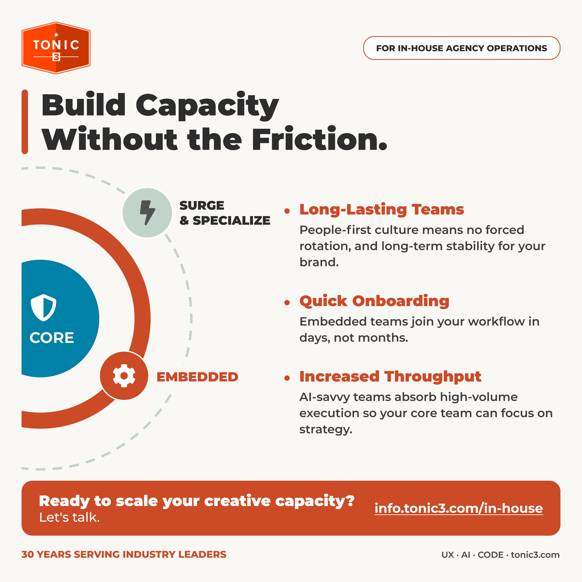
The Hybrid Capacity Stack, Tonic3's operating model for in-house creative capacity, built from more than a decade of scaling one enterprise in-house agency.
None of this is a universal answer. If your volume is occasional, a freelancer is still the simple choice, and a rebrand is still an agency conversation. The mistake is defaulting to whichever lever you used last without checking whether it fits the work in your queue.
Want the full walkthrough? We're sharing a companion deck that breaks down each layer and how to staff it. Request a copy from our Leader Jim Croall.
Prefer to talk it through? Talk to Tonic3 about managed teams
Tonic3 has spent 30 years building embedded delivery teams for enterprise in-house agencies. If you're working out which lever fits your team right now, the Hybrid Capacity Stack above is a good place to start.
Frequently asked questions
Should I hire a freelancer or use an agency for ongoing creative production?
Neither, if the work is truly ongoing. Freelancers are built for single, well-scoped projects, and agencies are priced and staffed for strategic work, not weekly production volume. Ongoing, high-volume execution is a better match for an embedded team or an on-demand platform, the two options built for sustained throughput.
What's the real difference between an on-demand creative platform and an embedded team?
An on-demand platform draws from a shared bench of creatives spread across many client accounts, so you rarely get the same person twice. An embedded team is a dedicated squad assigned to your account, so the people doing the work build up brand context over time instead of rebuilding it on every request.
Is it cheaper to add headcount or bring in a managed creative team?
It depends on how steady the volume is. Headcount makes sense when the work is consistent and strategic enough to justify a full-time role. A managed team makes more sense when volume fluctuates, because a managed team flexes up and down without a hiring or layoff cycle attached to every change in demand.
Will an embedded or managed creative team replace our in-house creative staff?
No. An embedded managed creative team is built to sit alongside your in-house team, not replace it. It absorbs high-volume production so your internal creatives can focus on strategy and brand work. An embedded team is a capacity lever, not a headcount reduction.