4 min read

Nearshore Development: Faster Delivery, Smarter Costs, Real Business Impact

Nearshore Development: Faster Delivery, Smarter Costs, Real Business Impact
4:12

Sometimes you need to move faster — but to be cost-conscious, the work must generate measurable bottom-line results. Nearshore development delivers that balance: it accelerates project delivery, closes talent gaps, and injects efficiency into complex programs by offloading specialized tasks to geographically and culturally proximate teams. Done well, nearshore partnerships reduce cost, speed time to market, and increase business agility without the coordination headaches of distant outsourcing.

Why choose nearshore?

  • Time-zone alignment: overlapping business hours enable real-time collaboration, faster feedback loops, and daily standups that actually work.
  • Cultural and language affinity: fewer miscommunications, smoother onboarding, and easier stakeholder alignment.
  • Cost-efficiency: lower labor costs than onshore teams while maintaining high quality and predictability.
  • Access to talent: scale specialized capabilities (AI/ML, cloud engineering, DevOps, data engineering, UX) quickly without long local hiring cycles.
  • Faster ramp and iteration: closer collaboration shortens discovery and development cycles, improving responsiveness to changing priorities.

Typical engagement models


  • Staff augmentation: add individual specialists to your existing teams for short- or long-term support.
  • Dedicated nearshore squads: full-feature teams (PM, engineers, QA, UX) that operate like an extension of your product org.
  • Project-based / fixed-scope delivery: vendor-managed delivery for well-defined initiatives.
  • Managed services / outcome-based: provider owns ongoing delivery and SLAs, measured by KPIs and business outcomes.
  • Hybrid onshore + nearshore: strategic leadership and stakeholder management retained locally; execution scaled nearshore.

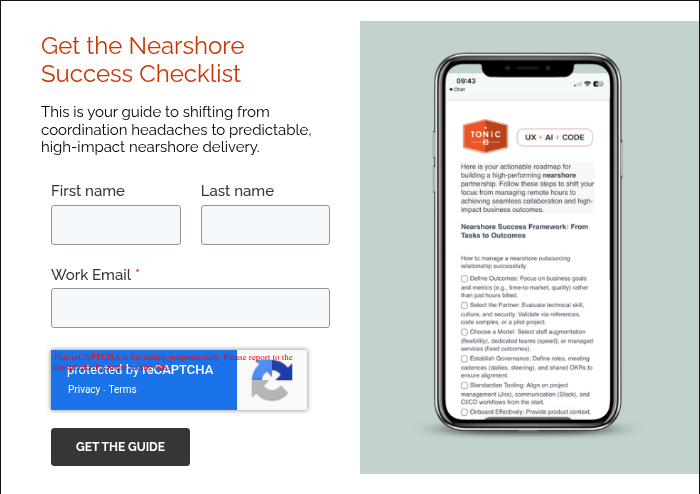
Get the Nearshore Success Checklist   This is your guide to shifting from coordination headaches to predictable, high-impact nearshore delivery.  


Common risks and mitigations

  • Miscommunication: use clear documentation, recorded demo sessions, and overlapping collaboration hours.
  • Quality drift: implement automated testing, code reviews, and CI/CD pipelines with quality gates.
  • Hidden costs: define scope boundaries, change-control processes, and transparent reporting on burn rates.
  • Security/compliance gaps: require third-party audits, endpoint protections, and strict access controls.
  • Retention and knowledge loss: encourage pair programming, documentation, and rotation policies to keep knowledge distributed.

Whats causing challenges for engineering
Your roadmap is set. Don't let resource gaps stall your journey. Clear the hurdles with Tonic3’s nearshore talent—your bridge to velocity and value.


KPIs to track success


When partnering with a nearshore provider, you need more than just "status updates"—you need hard data that proves the partnership is scaling efficiently.

At Tonic3, we eliminate the "outsourcing black box" by tracking seven specific KPIs. These metrics ensure that our nearshore teams are not just an external resource, but a high-performance extension of your core organization.

1. Delivery Velocity (Stories/Points per Sprint)

Velocity is our baseline for predictability. By tracking story points delivered per sprint, we provide CTOs with a reliable forecast for product roadmaps. This allows for better alignment with stakeholders and more accurate release planning.

2. Cycle Time and Lead Time

These are the true indicators of agility. We measure Lead Time (from idea to delivery) and Cycle Time (from start of work to "done").

By minimizing these, we ensure that your feedback loops are tight and that we are shipping value at the speed of your business.

3. Defect Escape Rate and Time-to-Fix

Quality is non-negotiable. We monitor how many bugs reach production (Defect Escape Rate) and how quickly they are resolved (Time-to-Fix). This transparency ensures that speed never comes at the expense of system stability.

4. Cost per Feature or per Sprint

We provide clear financial visibility. By understanding the cost per sprint or feature, CTOs can measure the direct ROI of their nearshore investment and make data-driven decisions on resource allocation.

5. Percentage of Overlapping Collaboration Hours Used

Nearshoring’s greatest advantage is time-zone proximity. We track the use of overlapping hours to ensure our teams are engaged in high-value, real-time collaboration with your US-based staff, reducing the friction common in offshore models.

6. Business Outcomes Tied to Releases

Engineering does not exist in a vacuum. We align our delivery metrics with your bottom line—tracking how specific releases impact revenue, customer satisfaction, and churn. If the code doesn’t move the business forward, our job isn’t done.

7. Employee Satisfaction/Engagement (In-house & Nearshore)

A healthy culture is a productive one. We monitor the engagement levels of both your internal team and our nearshore developers. High satisfaction leads to low turnover, which preserves institutional knowledge and keeps your project momentum strong.


When to use nearshore vs. other models

  • Use nearshore when you need rapid scaling of skilled teams with strong collaboration needs and some cost sensitivity.
  • Prefer onshore for extremely sensitive strategic work or where regulatory/legal constraints require local staffing.
  • Offshore can make sense for large cost arbitrage with looser collaboration needs, but usually increases coordination overhead.

Tonic3 Nearshore Development services


Tonic3 partners with organizations to accelerate delivery and produce measurable business results through nearshore teams tailored to your needs. Our services include:

  • Rapid team assembly (dedicated squads, staff augmentation, hybrid models)
  • Specialized capabilities: AI/ML engineering, data engineering, cloud-native development, DevOps, and UX
  • Pilot-to-scale delivery: discovery sprints, MVPs, and production rollout with measurable KPIs
  • Governance and tooling: set up CI/CD, observability, security posture, and delivery dashboards
  • Onboarding, training, and knowledge transfer to embed skills in your organization
  • Compliance and IP protection: contracts, NDAs, and security audits to protect your assets
  • Continuous improvement and cost optimization: process improvements, retrospectives, and workforce planning

We emphasize outcome-driven engagements, transparent reporting, and a collaborative approach to make nearshore work like an organic extension of your team. Contact Tonic3 to evaluate your priorities, run a pilot, and accelerate delivery without sacrificing quality or control.


Frequently asked questions about nearshore development

What are the primary benefits of choosing Nearshore Development over other outsourcing models?

Nearshore Development is characterized by key benefits such as Time-zone alignment, allowing for real-time collaboration and faster feedback loops; strong Cultural and language affinity, which minimizes miscommunications; and significant Cost-efficiency compared to onshore teams while maintaining high quality. It also grants rapid Access to talent for specialized capabilities (like AI/ML and DevOps).

 
What are the most common Nearshore outsourcing engagement models?

The typical engagement models include Staff augmentation (adding individual specialists to existing teams), Dedicated nearshore squads (full-feature teams operating as an extension of the product organization), Project-based / fixed-scope delivery, and Managed services / outcome-based models where the provider owns ongoing delivery based on KPIs.
 

What are the best practices and key metrics (KPIs) for managing a successful nearshore relationship?

Successful management requires IT leaders and those responsible for delivery to Define outcomes, not tasks; Pick the right partner with a strong culture fit; and set up strong governance with joint ownership. Team leaders and performance drives should measure continuously using KPIs to track success such as Delivery velocity, Cycle time and lead time, Defect escape rate, and business outcomes (like time-to-value and customer satisfaction).


Scaling Your Next Project: 5 Tips for Effective Resource Planning

Scaling Your Next Project: 5 Tips for Effective Resource Planning

Imagine resource planning as prepping for an ambitious mountain climb—those who reach the summit rarely get there by chance. If you skip mapping the...

Read More
The Truth About AI Budgets: Building, Running, and Staffing for Results

The Truth About AI Budgets: Building, Running, and Staffing for Results

Breaking Down AI Budgeting: The Build, The Run, and The People Let’s make AI budgeting simple: It’s all about three buckets—The Build, The Run, and...

Read More
Top Visual Tools for Agent Orchestration in Mid-Size Businesses

Top Visual Tools for Agent Orchestration in Mid-Size Businesses

Mid-size businesses are under immense pressure to streamline operations, but traditional code-first frameworks often create more bottlenecks than...

Read More