
 Delfina Castrogiovanni
From Design Thinking to AI Systems Orchestration
 Tonic3 : Oct 13, 2025, 7:15:00 AM
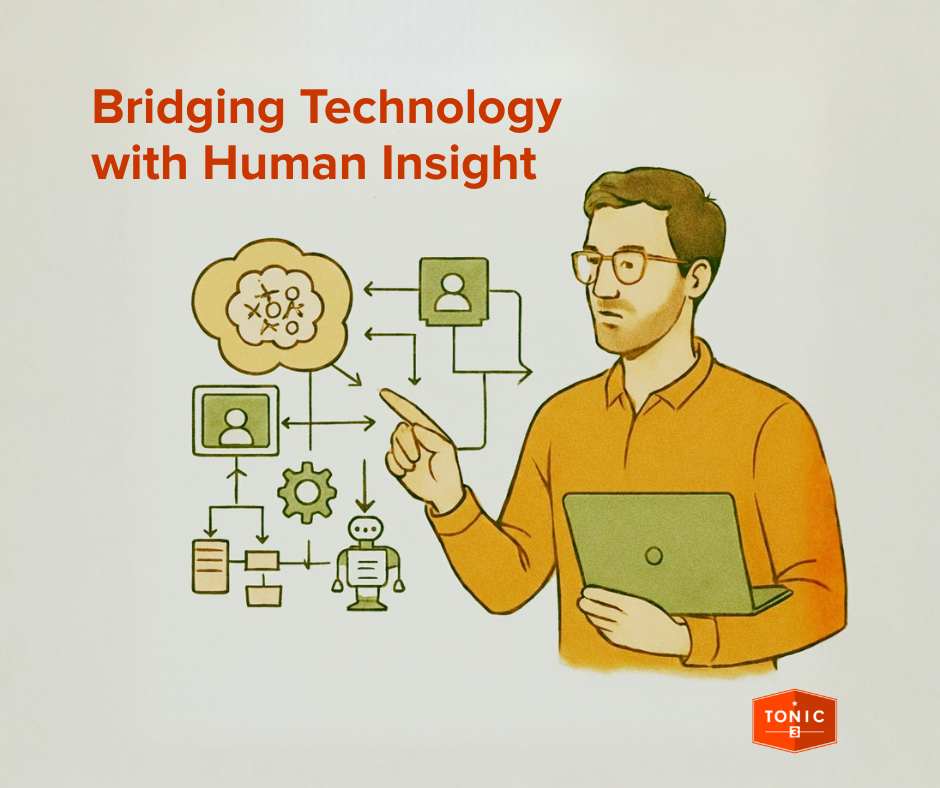
Explore the transformative journey from traditional design thinking to the innovative realm of AI systems orchestration, and understand how it is...

Mid-size businesses are under immense pressure to streamline operations, but traditional code-first frameworks often create more bottlenecks than they solve. I was discussing this challenge with my colleague Preston, Tonic3’s Director of AI & Emerging Technologies, and he highlighted a nuance that many overlook: in traditional development, syntax often gets in the way of architectural vision. That is the core reason why highly modular, visual agent builders are taking the lead in deploying and managing agentic AI orchestration.
These tools empower us to stop worrying about the code and start acting as true AI Systems Orchestrators. Justifying this approach is simple:
Moreover, visual agent orchestration tools are particularly valuable for mid-size companies that prioritize flexibility and cost-effectiveness. These businesses often operate with limited resources and need solutions that can adapt to changing demands. By leveraging open-source or light techstack options, mid-size businesses can achieve high efficiency without breaking the bank. The ability to visualize and manage agent workflows not only enhances productivity but also ensures that systems can scale seamlessly as the business grows.
While not visual builders themselves, powerful agent frameworks can be integrated into visual tools like FlowiseAI and Langflow. The ability to snap these components into a visual canvas is what elevates the low-code platforms from simple flow builders to true agent orchestrators.
Framework |
Primary Benefit to a Visual Workflow |
Systems Engineering Focus |
| CrewAI | Provides the structured core of multi-agent collaboration with defined roles and a clear final outcome, which a visual tool can then manage in a larger conditional flow. | Focuses on Role-Based Orchestration for repeatable, structured tasks, ensuring specialized agents stay on track. |
| LangGraph | Enables fine-grained control over flow by allowing cyclical behavior and conditional logic. In a visual tool, this looks like a complex decision-tree or feedback loop. | Focuses on Stateful, Graph-Based Architecture—critical for complex, multi-step processes where the agent must remember and react to previous steps. |
| LlamaIndex | Provides the advanced RAG (Retrieval-Augmented Generation) toolset that an agent needs. A visual block could represent a highly complex, LlamaIndex-powered knowledge retrieval engine. | Excels at Sophisticated Data Ingestion and Retrieval, making it ideal for information-heavy agents working with private data. |
| AutoGen | Introduces a dynamic, conversational layer where agents can chat and negotiate. A visual node could be a self-managing "AutoGen group chat" for open-ended problem-solving. | Focuses on Flexible, Conversational Problem-Solving, which is excellent for dynamic or exploratory tasks where a rigid sequence isn't possible. |

Langflow stands out as an excellent choice for mid-size businesses seeking a cost-effective and user-friendly visual agent orchestration tool. As an open-source platform, Langflow offers significant value by eliminating licensing costs and allowing businesses to allocate their budgets more strategically. This makes it an ideal option for teams that need to prototype and iterate rapidly without incurring hefty expenses.
One of Langflow's key strengths is its intuitive drag-and-drop interface, which simplifies the process of designing and managing agent workflows. This user-centric design ensures that even non-technical stakeholders can easily visualize and contribute to the development process. Langflow's compatibility with Python-based backends further enhances its appeal, as many developers are already familiar with this popular programming language. While Langflow excels in rapid prototyping and proof-of-concept projects, it may require additional optimization for high-scale, production-grade deployments.
For mid-size businesses that require a more robust and scalable solution, FlowiseAI offers a compelling alternative. Like Langflow, FlowiseAI is an open-source platform, providing excellent value without the burden of licensing fees. However, FlowiseAI distinguishes itself with its advanced features and superior performance, making it well-suited for production-ready applications.
FlowiseAI's user-friendly interface, built on Node.js and TypeScript, allows for deeper customization and greater control over agent workflows. This makes it an attractive option for businesses that need to handle complex branching logic and high concurrency. Additionally, FlowiseAI's ability to integrate seamlessly with Python-based frameworks like CrewAI ensures that businesses can leverage existing tools and expertise to build powerful, enterprise-grade systems.
.png?width=656&height=437&name=Tools%20Orchestra%20(2).png)
While visual agent orchestration tools offer numerous benefits, integrating them with code-first frameworks can further enhance their capabilities. Powerful agent frameworks such as CrewAI, LangGraph, LlamaIndex, and AutoGen can be seamlessly integrated into visual tools like Langflow and FlowiseAI, creating a more comprehensive development environment.
For instance, CrewAI provides a structured core for multi-agent collaboration, enabling businesses to define roles and achieve clear outcomes. LangGraph offers fine-grained control over workflows, allowing for cyclical behavior and conditional logic. LlamaIndex excels at sophisticated data ingestion and retrieval, making it ideal for information-heavy agents. AutoGen introduces a dynamic conversational layer, facilitating flexible problem-solving and negotiation among agents. By combining these frameworks with visual builders, businesses can create robust, scalable, and adaptive agent orchestration systems.
Open-source tools like Langflow and FlowiseAI offer mid-size businesses the perfect balance of flexibility and performance. These platforms provide the freedom to customize and adapt workflows to meet specific business needs, while also delivering high performance and scalability. By avoiding vendor lock-in, businesses can switch between different technologies and providers based on cost, performance, or availability, ensuring optimal resource allocation.
Moreover, the open-source nature of these tools fosters a collaborative community where businesses can share best practices, troubleshoot issues, and continuously improve their systems. This collective knowledge base can be invaluable for mid-size companies that may not have extensive in-house expertise. By leveraging open-source tools, businesses can achieve significant cost savings while maintaining the agility needed to thrive in a competitive market.

The real-world applications of visual agent orchestration tools are vast and varied. In customer service, for example, businesses can deploy chatbots that integrate seamlessly with CRM systems, automating routine inquiries and freeing up human agents for more complex tasks. In healthcare, agent orchestration can streamline patient data management, connecting diagnostic AI models with electronic health records to improve accuracy and efficiency.
Consider an AI-powered sales dialer that not only schedules appointments but also analyzes conversational tone and learns from interactions. By understanding the entire ecosystem—how it connects to the CRM, schedules follow-ups, and adapts based on user behavior—businesses can create more efficient and adaptive systems. These real-world use cases demonstrate the transformative potential of visual agent orchestration tools, driving productivity and innovation across various industries.
"It’s not about becoming more technical. It’s not about knowing more code. It’s about guiding intelligence systems—and building the future through them."
By focusing on flexible, cost-effective visual tools like Langflow and FlowiseAI, mid-size businesses can harness the power of agent orchestration to enhance productivity and drive growth. These platforms offer the perfect blend of user-centric design, advanced features, and scalability, making them ideal choices for businesses seeking to optimize their operations without compromising on performance.
 Tonic3 : Oct 13, 2025, 7:15:00 AM
Explore the transformative journey from traditional design thinking to the innovative realm of AI systems orchestration, and understand how it is...
.png) Tonic3 : Jun 3, 2025, 9:20:33 PM
Tonic3 : Jun 3, 2025, 9:20:33 PM
Optimization and productivity for frontline workers. Give them the custom-built orchestrated AI. Integrate Operational Technology (OT) and...
 Marion Decobert : Jan 29, 2026, 5:01:23 PM
Discover how nearshore development accelerates project delivery, reduces costs, and enhances business agility through strategic partnerships and...