The Truth About AI Budgets: Building, Running, and Staffing for Results
Breaking Down AI Budgeting: The Build, The Run, and The People Let’s make AI budgeting simple: It’s all about three buckets—The Build, The Run, and...
Tonic3 develops and executes strategies that drive profit through Digital Transformation. Practically that means we are built to help clients hone the right strategy, implement the right technology, and build the right long-term capabilities to deliver lasting transformation.
Industries
We believe that effective technology helps people succeed in their daily lives. So we help our clients engineer useful technology for their clients, partners, and employees. That translates to every major industry, but over the years we’ve developed several core areas of expertise.
2 min read
Marina Uchoa
:
May 15, 2026 6:23:04 PM
If you've looked at an AI budget template and still haven't moved forward, the problem probably isn't the numbers — it's that IT and the business are solving for different things.
Most AI budgeting conversations fail before they start. IT asks about architecture and security. Business leaders ask about win rates and client impact. Both are right. Neither is speaking the other's language. And without a shared framework, decisions stall, pilots get duplicated, and shadow AI projects quietly multiply.
If that sounds familiar, here are four things you can act on now.
Before you open a spreadsheet, get IT and business leaders in the same room and surface where they actually disagree. These three questions tend to crack it open fast:
If you can't agree on answers to these, the budget conversation will keep going in circles. Get alignment here first.
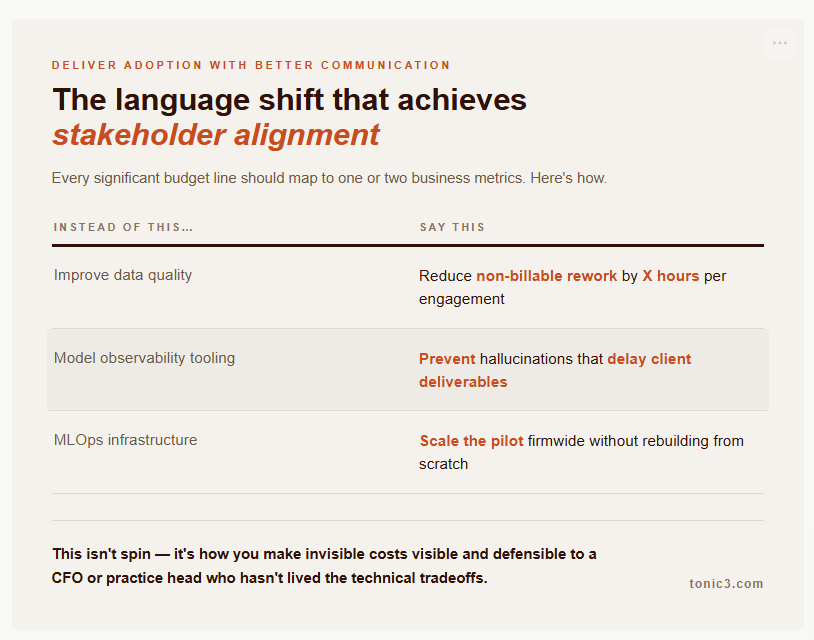
IT leaders often justify infrastructure spend in technical terms. Business leaders tune out. The fix is a consistent translation habit: every significant budget line gets mapped to one or two business metrics.

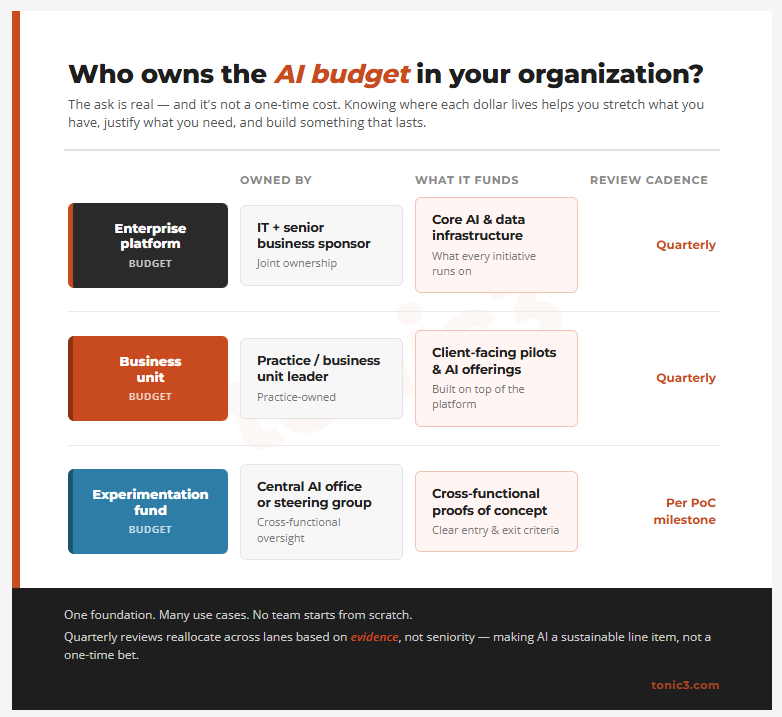
A recurring fight in professional services AI budgets: "Who pays for the shared platform?" The cleanest resolution is a three-swimlane structure that separates ownership by type of spend.

For a CIO trying to stretch limited AI budget, the practical move is to separate spend into swimlanes, because each one requires a different stakeholder conversation, a different approval path, and a different standard for proving value.
Where the AI budget lives should shape how the CIO builds the case, who they align with, and how they pace investment, which is why a three-swimlane model works better than forcing every initiative through the same funding conversation.
Quarterly reviews, not annual, let you reallocate across swimlanes based on evidence, not politics.
Sticker shock and scope creep both come from incomplete cost visibility. Before any AI initiative gets approved, map it across all three layers:
Build Platform licensing, integration work, data preparation, and the initial project team. This is what most proposals include — but rarely all of it.
Run Cloud compute, model inference, monitoring, security, and compliance. Often missing from early-stage budgets. Almost always the source of surprise costs at scale.
People Central AI engineering, embedded product owners in practices, and any vendor or contractor support. Decide up front whether this is centralized or distributed — and put it in the budget either way.
Simple use cases land toward the low end of each layer. Multi-agent, cross-firm systems land at the high end. The framework keeps both honest.
If these questions are surfacing real gaps in how your firm is approaching AI investment, let's talk through them. Or join our next Learning Lab session — a working session built around exactly these budget and alignment challenges.

Breaking Down AI Budgeting: The Build, The Run, and The People Let’s make AI budgeting simple: It’s all about three buckets—The Build, The Run, and...
At Tonic3, we are hearing one question more than any other from business leaders eager to adopt AI: "How do we budget for a project when the cost is...
Your infrastructure is already stretched—ticket queues are growing, shadow IT is creeping in, and stakeholders still expect faster delivery with the...