3 min read

AI-Powered Risk Assessment: Defensible, Explainable Risk Management

AI-Powered Risk Assessment: Defensible, Explainable Risk Management
5:18

In the current regulatory environment, transparency is essential. Regulators require detailed explanations for identified risks, and vague responses are inadequate. Technology leaders in financial institutions face the challenge of providing tools that generate clear and defensible assessments, with decisions that can be traced back to their data sources for accuracy. This task is further complicated by data noise, numerous false positives, and compliance tools that are often complex and inflexible.


This is where AI-powered risk assessment steps in as a transformative solution. While not a cure-all, it holds the promise of cutting through the noise to uncover genuine threats hidden beneath the surface. Picture a system that learns and adapts, spotting patterns and anomalies beyond human detection. What if that system also automates mundane tasks, liberating teams to concentrate on strategic initiatives that truly matter. Imagine a system that delivers the clarity and defensibility regulators require. It would mean we are making AI awesome for a specific user -- risk assessors.

Considerations for Implementing AI-Powered Risk Assessment 


CTOs in the banking sector have a unique opportunity to leverage AI-driven solutions to transform risk assessment processes, achieving both scalability and efficiency. By automating risk detection and evaluation, AI can significantly reduce assessment timelines from a week down to as little as two days. This accelerated, data-driven decision-making allows for more agile responses to potential threats.

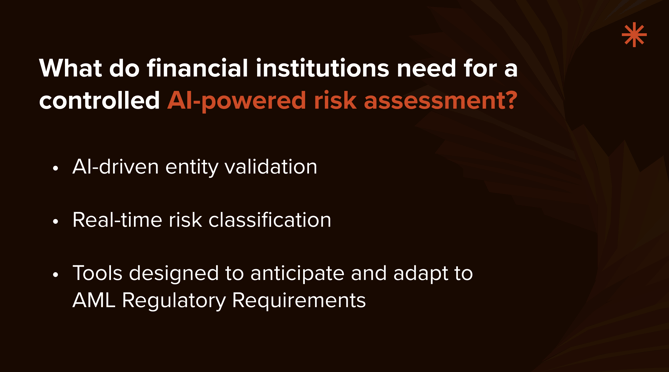
What do financial institutions need for a controlled AI-powered risk assessment?

  • AI-driven entity validation
  • Real-time risk classification
  • Tools designed to anticipate and adapt to AML Regulatory Requirements
Combined with multiple task-specific Agents, teams can build in checks and quality review to meet specific business rules
    

AI Transformation


AI-powered entity validation and risk classification offer enhanced accuracy by minimizing false positives. This not only improves the precision of flagged risks but also ensures auditability and regulatory alignment through explainable risk scoring and customizable compliance thresholds. By streamlining AML due diligence workflows and enhancing investigations, AI-driven risk assessment presents a viable and scalable solution for CTOs seeking to modernize their institution's risk management capabilities.


Desired Outcomes for CIOs and CTOs responsible for risk assessment tools:


Reduce Risk Assessment: Achieving a significant reduction in risk assessment time is a primary goal, accomplished through the implementation of automated entity validation, sophisticated risk classification, and advanced web scraping techniques for comprehensive data collection and analysis. This streamlined process not only accelerates decision-making but also enhances the overall efficiency of risk management operations.

Minimize Compliance Fatigue: Alleviating compliance fatigue is another critical outcome, achieved by employing explainable risk scoring mechanisms and AI-driven strategies to minimize false positives. This approach allows investigators to concentrate their efforts on genuine threats, thereby optimizing resource allocation and improving the accuracy of risk assessments.

Customize Risk Thresholds: Ensuring defensible and transparent compliance decisions is paramount, supported by the development of customizable risk thresholds that are in harmony with evolving regulatory standards. This approach is not about replacing human judgment; rather, it is about enhancing and empowering it. By equipping teams with the necessary tools, they can perform their roles with greater effectiveness, safeguarding the financial institution against the relentless tide of risk.

Ultimately, the goal is to achieve peace of mind for technology leaders. This isn't about replacing human judgment; it's about enhancing and empowering it. It's about equipping teams with the tools they need to perform their roles effectively, safeguarding the financial institution against the relentless tide of risk. With these advanced tools in place, the blinking cursor no longer taunts technology leaders, but instead, it allows them to focus on exploring the next opportunities for adopting cutting-edge AI solutions. This forward-thinking approach not only addresses current challenges but also positions the institution for future success in an ever-evolving regulatory landscape.

EmbraceAgenticAI-startsmall-viewdemo


Building Momentum: Adapting AI-powered Risk Management Tools 

In today's fast-paced digital landscape, the ability to adapt and innovate is crucial. By partnering with Tonic3, IT Leaders can harness the power of customized agents and workflows to streamline operations, enhance user experiences, and drive growth. Our team of experts is dedicated to providing solutions that are not only innovative but also reliable and tailored to your unique needs.

Ready to transform your processes and elevate your business? Connect with us today to explore how we can help you achieve your goals with cutting-edge technology and personalized support.


Frequently Asked Questions

How does AI-powered risk assessment improve accuracy in identifying financial risks?
AI-powered risk assessment enhances accuracy by leveraging advanced algorithms to analyze vast datasets, identifying patterns and anomalies that may be missed by traditional methods. This technology minimizes false positives, ensuring only genuine threats are flagged. By providing explainable risk scoring and customizable compliance thresholds, AI tools align with regulatory requirements, offering a transparent and defensible approach to risk management.
What are the benefits of implementing AI-driven solutions for risk assessment in financial institutions?

AI-driven solutions reduce risk assessment timelines from weeks to days, automate risk detection, and enhance response agility. They focus on genuine risks, optimize resources, and improve assessment accuracy, empowering teams to make informed decisions and safeguard against evolving risks.

How can financial institutions ensure the successful integration of AI-powered risk assessment tools?

Financial institutions should start by defining key metrics and data sources, ensuring that AI solutions are tailored to their specific needs. Collaboration with technology partners like Tonic3 can facilitate the customization of agents and workflows, streamlining operations and enhancing user experiences. Continuous feedback and iteration are crucial to refining these tools, ensuring they remain effective and aligned with regulatory standards.


Schedule a Demo and Start Moving Forward


How to Get Started with Agentic AI: Implementation Roadmap

How to Get Started with Agentic AI: Implementation Roadmap

So, you've reached a point where operational KPIs seem to be plateauing? You're seeing customer ticket volumes that just won't budge? It's a common...

Read More
AI Agents Have Arrived: The Clock is Ticking on AI Governance

AI Agents Have Arrived: The Clock is Ticking on AI Governance

“AI agents are coming!” If that phrase triggers flashbacks of Paul Revere, you're not alone. The alarm is justified—AI’s impact on business isn't...

Read More
Decoding the AI Revolution: Exploring the edges for enterprise scalability

Decoding the AI Revolution: Exploring the edges for enterprise scalability

The realm of Artificial Intelligence is currently experiencing a surge of groundbreaking advancements. From the development of sophisticated large...

Read More