5 min read
Definition Risk: The Trend Quietly Stalling AI Plans in Regulated Industries
Ale Sanchez
:
Sep 16, 2026, 3:55:02 PM
If your last AI initiative stalled somewhere between the roadmap and the rollout, you're not the outlier you might think you are. There's a trend emerging across regulated industries, and it's starting to reshape how they plan for AI — not what AI can do, but what has to be true before they build it. Banking, insurance, and health care are all under real pressure to move on AI, even as the risk they carry keeps them naturally more cautious than most industries. And many of the projects that do move forward are stalling out for the same root cause: definition risk.
The Bottom Line: The Quick Read for CIOs
-
- Banking, insurance, and health care are all under pressure to move fast on AI while managing real risk — and many of their AI projects are stalling for the same reason.
- We call that reason definition risk: leadership sets a goal, but the organization never defines it clearly enough for AI to act on it.
- We've seen this show up, unprompted, in three separate industries. That's not a coincidence — it's a trend.
- Closing it takes two things: a defined, checkable standard, and a governance process with real teeth — not just a document nobody revisits.
- Definition risk is one of several go/no-go questions worth resolving before an AI investment decision — not the only one.
It kept showing up. Different client, different industry, same wall — long enough that we stopped calling it a coincidence. Now leaders in multiple industries are describing the same problem in their own terms. A Fortune 500 CEO pointed to it in health care. An insurance CTO described a related version of it in their own market. At an AI conference our team attended, banking and fintech leaders gave us the same story in real terms: the tech was not the problem. The missing definition was.
One example stuck with us. Leadership wanted AI to "streamline underwriting." But legal, tech, and business teams each had a different view of what a correct decision actually looked like. That gap is definition risk. And in regulated businesses, it does more than delay a project — it shapes how the company governs decisions, builds systems, and tries to turn AI into something defensible and real.
How Definition Risk Shows Up Across Banking, Insurance, and Health Care
That CEO — a former U.S. health policy official — wrote in the New York Times that the real reason U.S. health care is so expensive isn't insurance or who pays for it. It's that physician judgment swings wildly from doctor to doctor, hospital to hospital, region to region — nobody's ever pinned down what "necessary care" actually means at the moment a doctor has to decide. That's definition risk. He just never called it that.
The insurance CTO's version was different in shape but the same at the root: carriers plugging in the same third-party AI vendors, running the same models on the same data, without ever building an owned definition of their own risk logic underneath it. No inconsistency — just borrowed judgment nobody at the company could actually explain.
Different mechanics, same failure: banking, insurance, and health care are each hitting this wall in their own way, but it's one wall.
Why Definition Risk Heavily Impacts Regulated Industries
If a shopping app's AI gives a so-so recommendation, no one gets hurt — you just lose a sale. In banking, insurance, and health care, a decision built on a fuzzy definition doesn't just underperform. It's a decision nobody can defend if a regulator, auditor, or lawyer asks "why did the AI do that?"
That's the real reason these industries can't move as fast as everyone else on AI. It's not that the tech is harder to use — it's that skipping the definition work costs a lot more when things go wrong. Everyone feels pressure to move fast. But moving fast without nailing down the definition first just gets you to the wrong answer faster.
We're not compliance experts, and we won't pretend to be — but it's worth a quick note: even fresh regulatory guidance for banks is still catching up to AI agents, not fully covering them yet. That gap isn't going to close on your timeline. Which means the definition work has to happen inside your organization, not wait for regulators to hand you the answer.
How CIOs Can Close the Definition Risk Gap
The health care example is useful because it doesn't just describe the problem — it shows what actually fixes it. Two things, working together:
- A clear standard the AI is built against. Certified, evidence-based guidelines that a decision can be checked against, so "the right call" isn't left up to whoever's making it that day.
- A governance process with real teeth. Doctors who follow the certified guideline are presumed to have done their job right. The standard isn't just a document — it changes what happens when someone reviews the decision later.
Most companies skip that second part. They write a definition once, in a kickoff deck, and it never actually governs anything downstream. We've written before about what it takes for AI-driven risk decisions to hold up under scrutiny, not just look accurate — same idea here. A definition only closes the risk if it's specific enough, and built into the process enough, to survive being questioned.
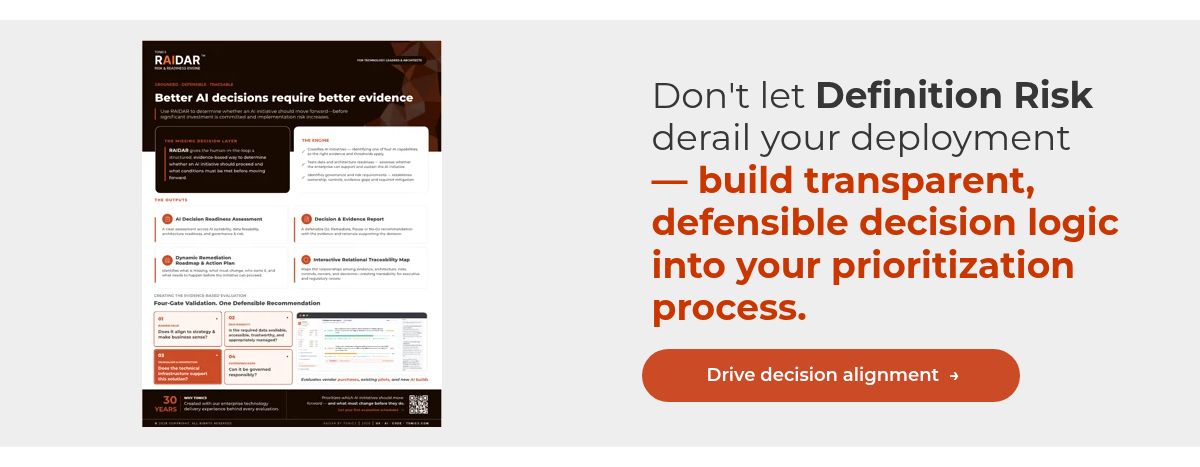
This is exactly the kind of question we built RAIDAR, our AI decision-readiness framework, to surface before a project gets a green light — not after.
The CIO Takeaway: Resolve Definition Risk Before You Build
You can't fix definition risk with better AI. You fix it before you build anything, by getting legal, tech, and business teams to agree — specifically — on what a correct decision looks like.
That agreement takes longer than a proof of concept. But it's the difference between a pilot that looks good in a demo and a system that survives its first audit. We've written about this same pattern from the CIO's seat — the companies actually getting ROI from AI spend are the ones treating governance as infrastructure, not paperwork.
Definition risk is one of several go/no-go questions worth resolving before an AI investment moves forward — not the only one. If you're building out what that full readiness check should look like before your next AI decision, [that's exactly what RAIDAR is built to walk you through].
This is the trend quietly stalling AI plans in regulated industries: not a race to deploy fastest, but a race to define clearly enough to deploy at all. The ones who get ahead of it now are the ones still standing when the first ungoverned pilot fails in public.
Frequently Asked Questions about Regulated Industries and AI projects
What is "definition risk" in AI adoption? It's the gap between what leadership wants AI to do and what the organization has actually defined clearly enough for AI to act on. It shows up when legal, tech, and business teams each have a different idea of "the right decision" and never reconcile it before building anything.
Why do regulated industries struggle with this more than other industries? Not because the tech is harder to use — because a fuzzy AI decision is much more expensive to defend in banking, insurance, and health care. A vague recommendation costs a sale in retail. It costs a compliance finding in finance. We've now seen this pattern named or described independently in all three.
How do you actually close definition risk? Two things: a clear, checkable standard the AI is built against, and a governance process that has real consequences — not just a document nobody looks at again, but something that changes the outcome when a decision gets reviewed.
Sources: Tonic3 team conversations with banking and fintech leaders; Peter R. Orszag, "Why Both Republicans and Democrats Are Wrong About Health Care," The New York Times (Opinion); Matt Wielbut, co-founder and CTO of Openly, "2026 Is the Inflection Point for Insurance AI," The Open Door (Openly company blog).
Related reading: