6 min read

How CIOs Turn AI Spending Into Business Impact: Adoption, Governance, and ROI

How CIOs Turn AI Spending Into Business Impact: Adoption, Governance, and ROI
10:53

You already know AI adoption is broken. Here is what you actually do about it. 


I spend a lot of time in rooms with CIOs. And the conversation I keep having — at conferences, in strategy sessions, in follow-ups after events — is some version of the same thing: we are spending more on AI than ever before, and we have very little to show for it.

Right now, AI is consuming 35 cents of every enterprise technology dollar — with budgets nearly doubling in the last year. And yet almost half of leaders admit their AI adoption has been a massive disappointment that isn't capturing its potential value.

The technology works in isolation. The daily work is breaking down.

If you've read our piece on why AI adoption keeps failing, you already understand the root cause: this isn't a technology problem. It's a design problem. But knowing that doesn't tell you what to do Monday morning.

This article is the practical companion. It answers the two questions I hear most often from CIOs navigating this exact moment. 


The Question I Hear Most From CIOs Right Now

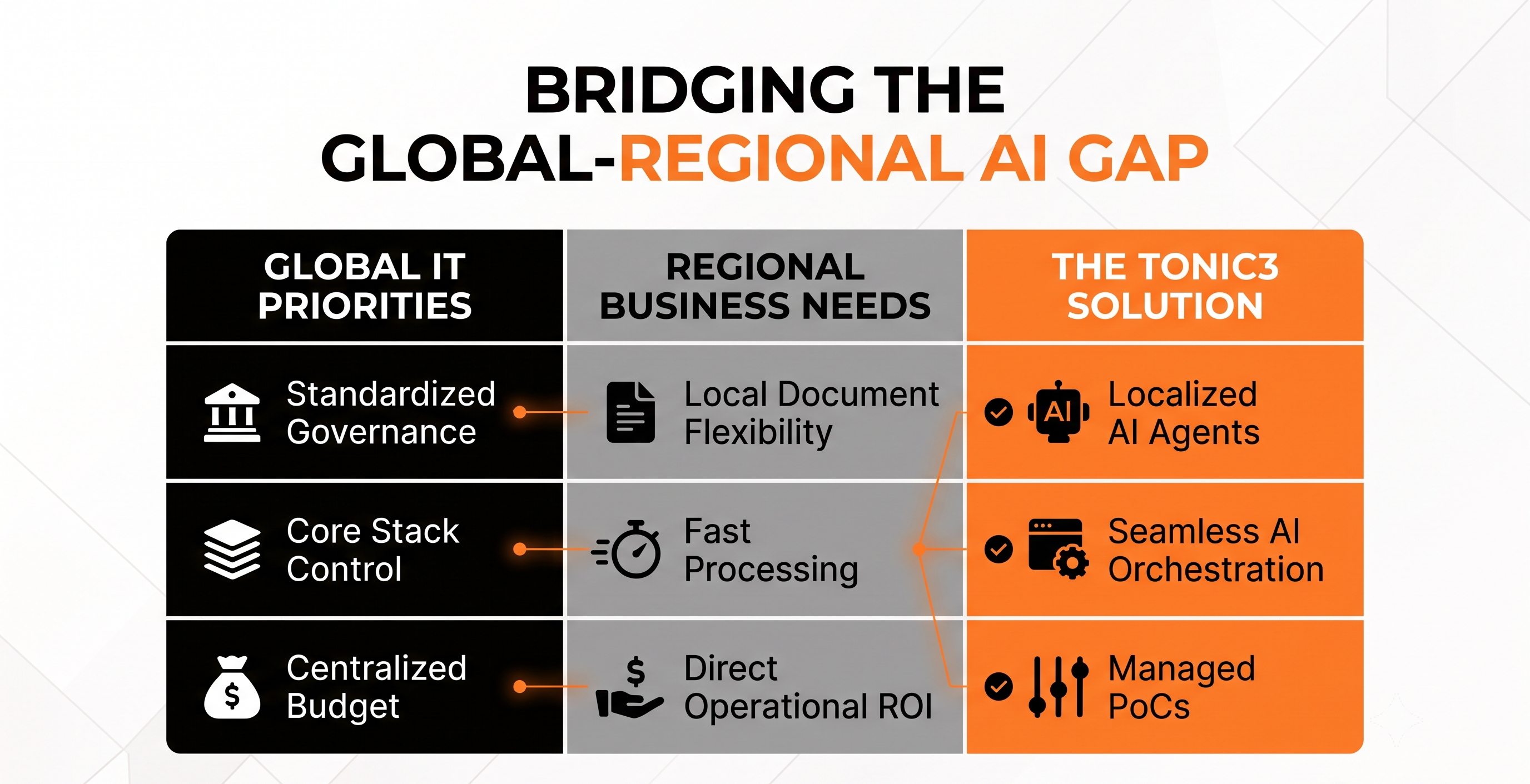
How do I avoid overspending on AI that never makes it into the workflow, when I need to stretch my budget, AND ensure there's an immediate ROI? 


It means treating human needs and behaviors as the primary design constraint — not a final UX layer you apply at the end of a technical build.

In practice, that looks like three specific shifts:

Starting with real workflows and pain points, then designing AI into them — not the other way around. The AI serves the workflow. The workflow does not contort to serve the AI.

Making responsibilities, oversight, and risk boundaries explicit for every AI use case before deployment — not after something goes wrong. Different types of AI carry categorically different risk profiles, and your governance needs to reflect that from day one.

Measuring success not just by model performance, but by ease of use, trust, and actual adoption rates. A system your team doesn't use isn't a system. It's a budget line.

Human-centered design is now the deciding factor between AI that gets used and AI that gets ignored. That's not a design philosophy. It's a business outcome.


Where AI Investments Start to Go Sideways

When budgets tighten, the instinct is to do the AI initiative anyway — just with less. Pull in whoever is available rather than whoever is right for the job. Start with the data you have rather than the data you need. Skip the experience design layer because it feels optional next to the technical requirements. Move fast because the board is watching.

What follows is predictable: the project misses its first deadline, then its second. Rework begins. The team discovers the data wasn't ready and spends weeks cleaning what should have been cleaned before a single line of code was written. The product that eventually ships carries new technical debt that will slow down every project that comes after it. And after all of that — the adoption numbers are still disappointing, because the humans who were supposed to use it were never really designed for.

I heard our CEO Joe Edwards put it plainly to a room full of CIOs at a recent event: "The most expensive IT investment is the one that never gets used. But there's a version that's even more expensive than that — the one that gets built twice."

He's right. And the corner-cutting spiral is exactly how you end up building things twice.

This connects to something else Joe said in that same conversation — that the value equation for AI has fundamentally shifted: "The volume of data generated by AI no longer correlates with respect for the level of effort put in. Analysis is the only thing we value now — because anyone can prompt a report into existence."

When output is cheap to generate, the scarcity becomes human judgment — the expertise, context, and trust that makes AI output actually usable. Organizations that cut the experience design layer aren't saving that investment. They're eliminating the one thing that turns AI from a report generator into a business capability.

Getting it right from the start isn't a premium on top of the budget. It's the budget strategy.


What Friction Is Really Costing IT Leaders

When AI doesn't fit how people work, they don't adapt. They route around it.

Employees are currently losing 51 working days a year — one full day every week — to software and AI friction alone. Constantly switching between disjointed tools. Decoding missing context. Re-entering data that should flow automatically. This is the hidden tax on every AI investment that doesn't account for the human experience of using it.

The consequence isn't just lost productivity. It's Shadow AI.

Because approved tools are clunky or don't fit real workflows, a two-tiered workforce is emerging. A significant portion of employees are now using unapproved AI tools to bypass broken processes — and a substantial number of those users are feeding confidential company data into systems your IT team has no visibility into.

This isn't defiance. It's rational behavior. 

"The challenge for leaders today is to provide technology at work that is better than technology at home. This is the only way to fight Shadow AI. If employees feel their home tools are more effective than their locked-down work tools, they will bypass your governance every single time."

Joe Edwards, CEO, Tonic3


The governance problem and the adoption problem are the same problem. You cannot solve one without solving the other.


Why Launch Is Not the Finish Line

Before we get to the framework, there's one belief you need to replace.

Most CIOs in this situation are asking: "How do I deploy better AI?"

That's the wrong question. It keeps the human as the variable you're trying to manage around the technology.

The right question is: "How do I design better experiences around AI?"

When you treat human needs, fears, existing workflows, and risk tolerance as the starting point — not the constraint — you stop running a technical project and start building an adopted capability. That shift is where the real breakthrough happens. Not in the model. Not in the vendor selection. In the design of the experience around them.

This is also the shift that protects your budget. A project built around the human from day one doesn't need to be rebuilt.


The Framework We Use to Turn AI Spend Into Actual Use

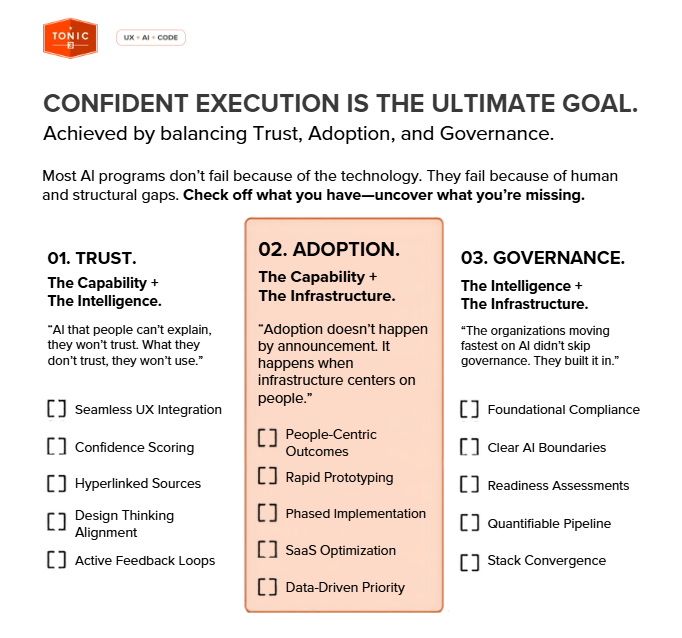
When we work with organizations on Enterprise AI Strategy, we use a framework called Confident Execution. It's what happens when three things overlap correctly: 

Trust (UX + AI):

Human trust has to be established before anything else works. If someone stops mid-task because they don't understand or trust the AI's output, the entire investment fails at that moment. This means building explainability directly into the interface — not as a technical feature, but as a design decision. Confidence scores, visible data sources, clear feedback loops. The human needs to see how the system reached its conclusion, and they need a path to correct it when it's wrong.

Adoption (UX + Code):

Adoption is not a training problem. It's an Intelligent Process Engineering problem. The system has to fit into how people actually work — their rhythms, their handoffs, their existing mental models — or they will work around it. This is where most enterprise AI investments break down: the build optimizes for technical performance and assumes adoption will follow. It won't. Adoption has to be engineered in, from the first design decision.

Governance (AI + Code):

Governed AI isn't slower AI. It's AI that survives contact with the real world. This means defining boundaries — what the system is and isn't permitted to do — before deployment, not after an incident. It means building Human-in-the-Loop checkpoints at the moments that carry real risk. And it means recognizing that a summarization tool and an autonomous agent are not the same governance challenge. They require fundamentally different controls.

The organizations seeing real ROI from AI aren't the ones with the biggest budgets or the newest models. They're the ones that got all three of these layers working together.


What Strong AI Programs Keep Measuring After Go-Live 

One of the most common mistakes in enterprise AI deployment is treating launch as the finish line.

Joanne Kok, our Director of UX, said something that can reframe your thinking:

Introducing AI acts as a force multiplier. Any change, any new data generated, is going to come at a volume we've never seen before. There is simply no excuse now for not building in a continuous evaluation loop."

At the scale AI operates, small design flaws compound quickly. A trust gap that affects 10% of interactions becomes a significant liability when those interactions happen thousands of times a day. A governance boundary that seemed sufficient at launch may be inadequate six months later as the system encounters new edge cases.

The evaluation loop isn't a post-launch nice-to-have. It's the mechanism by which confident execution stays confident over time. Build it in from the start — a structured process for measuring ease of use, trust signals, adoption rates, and governance compliance — and you have the infrastructure to catch problems before they become crises.


What to Fix First Before You Spend Another Dollar

If you feel stuck today, the most important thing isn't a new vendor or a bigger budget. It's a more honest assessment of where your current AI program actually stands.

In my experience, that means looking at your workflows first — not your models. Where is friction being created? Where are employees routing around approved tools? Where are the trust gaps that are causing people to pause, verify manually, or abandon a process entirely?

From there, the path to Confident Execution is iterative. Find a real starting point. Build an early win that demonstrates what human-centered AI design actually feels like to use. Measure it honestly — not just by technical output, but by adoption, trust, and the reduction of friction. Then expand.

Progress over perfection. That's how you get from AI spending to AI working.


A Practical Way to Assess Where Your Projects Stand

If you want to understand where your AI program stands across Trust, Adoption, and Governance, our Confident Execution Checklist gives you a practical starting point — and a conversation about what comes next.


Let's build AI your teams will actually use.


Sources: WalkMe State of Digital Adoption 2026 · Writer AI Adoption in the Enterprise 2026