3 min read

Intelligent Process Engineering: Designing Human-Centered, Autonomous Workflows

Intelligent Process Engineering: Designing Human-Centered, Autonomous Workflows
5:26


Automation alone isn’t enough. Organizations need Intelligent Experiences—processes redesigned so people, data, and autonomous AI agents work together smoothly to deliver faster, more reliable outcomes. Intelligent Process Engineering (IPE) is the practice of mapping, rethinking, and rebuilding workflows so they can be executed and orchestrated by smart systems while keeping human judgment where it matters most.

What is Intelligent Process Engineering? IPE goes beyond scripting repetitive tasks. It combines process discovery and modeling, decision logic design, AI and agent orchestration, systems integration, and human-in-the-loop design to create end-to-end, adaptive workflows. The goal is not only to reduce manual effort but to transform how work flows across people and systems—improving speed, quality, and the overall experience for employees and customers.

How IPE relates to “intelligent automation”

“Intelligent automation” is the broader capability that combines robotic process automation (RPA), AI/ML, natural language processing, process mining, and orchestration to perform complex activities autonomously. Intelligent Process Engineering is the design discipline that makes intelligent automation effective: it reveals which processes to automate, defines the logic and decision boundaries for autonomous agents, and ensures that automation aligns with business objectives and human workflows.


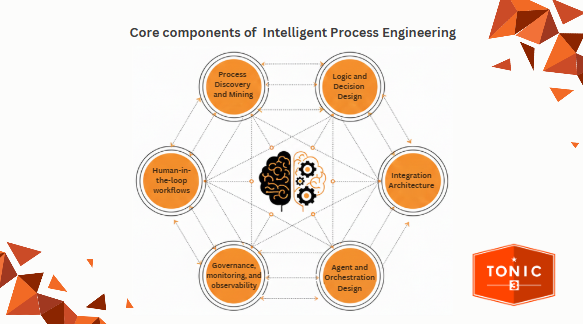
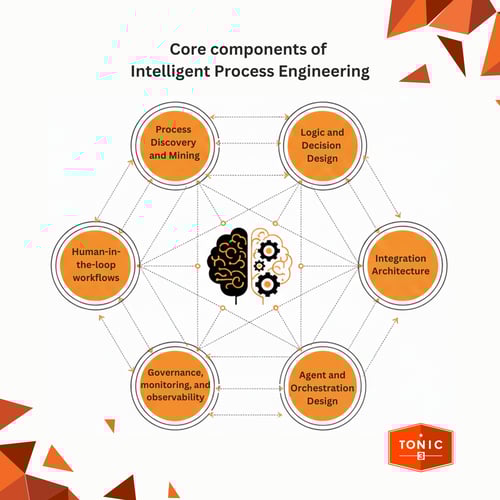
Core components of Intelligent Process Engineering

  • Process discovery and mining: Use logs, interviews, and tools to map real-world process variants, handoffs, and bottlenecks.
  • Logic and decision design: Convert workflow steps into explicit logic, exception rules, and decision points suitable for AI agents.
  • Agent and orchestration design: Define how autonomous agents, human roles, and systems interact, including sequencing, routing, retries, and fallbacks.
  • Integration architecture: Design APIs, data interfaces, and middleware so information flows reliably between systems and agents.
  • Human-in-the-loop workflows: Identify where human review, approvals, or creative problem-solving are required and design smooth handoffs.
  • Governance, monitoring, and observability: Build performance metrics, audit trails, and guardrails for compliance, explainability, and continuous improvement.

Inteligente Engineering Proc


Benefits for organizations implementing IPE

  1. Higher throughput and lower cycle times by removing unnecessary handoffs and automating repetitive tasks.
  2. Improved accuracy and compliance through standardized decision logic and traceable workflows.
  3. Better employee experience: remove tedious work, enable higher-value activities, and retain human oversight of exceptions.
  4. Faster innovation and agility: modular, well-modeled processes can be evolved or repurposed quickly.
  5. Measurable business outcomes: clearer KPIs and feedback loops drive continuous optimization.

Typical use cases

  • Finance operations: automated invoice processing with AI-based OCR, fraud scoring, and approval orchestration.
  • Customer service: intent detection, automated case routing, and assisted resolution with agent handoff.
  • HR onboarding: document verification, entitlement provisioning, and staged human approvals.
  • Supply chain: automated order validation, exception handling, and multi-system reconciliation.

A practical methodology to implement IPE

  1. Assess & discover: process mining, stakeholder interviews, and value prioritization.
  2. Define target state: map the redesigned workflow, roles, decision rules, and KPIs.
  3. Prototype & pilot: build minimal end-to-end flows with representative data and measure impact.
  4. Scale & integrate: extend automation across systems, introduce orchestration, and harden security.
  5. Govern & iterate: establish monitoring, retraining cycles for models, and continuous improvement loops.


Key considerations

  • Data quality and availability: AI-driven steps require reliable, well-understood data sources.
  • Change management: involve users early and provide training; redesigns change daily work patterns.
  • Security and compliance: preserve auditability and control over automated decisions.
  • Explainability: design decision logic and model outputs so humans can inspect and intervene when needed.
  • Scalability: choose architectures and platforms that support growth without brittle point-to-point integrations.
  • Measuring success Focus on outcome-based KPIs: cycle time reduction, error rate decline, cost per transaction, employee time reallocated to high-value work, and customer satisfaction improvements. Tie improvements directly to strategic goals to prioritize efforts with the highest business impact.

At Tonic3, we partner with organizations to transform routine operations into intelligent, resilient workflows. Our Intelligent Process Engineering services include process discovery and mining, logic and agent design, integration and orchestration architecture, pilot delivery and scaling, governance and observability frameworks, and change management and training. We help you retain the right level of human oversight, while deploying autonomous agents that accelerate outcomes and align with strategic goals. Contact Tonic3 to evaluate your processes, prioritize high-impact opportunities, and build intelligent experiences that boost productivity, compliance, and employee engagement.


Frequently Asked Questions for Intelligent Process Engineering:


What is Intelligent Process Engineering (IPE)?
Intelligent Process Engineering (IPE) is the design discipline for creating human-centered, autonomous workflows. It involves mapping, rethinking, and rebuilding processes so they can be executed and orchestrated by smart systems while ensuring human judgment remains where it is most critical.
What are the core components of Intelligent Process Engineering?
The core components of IPE include: Process discovery and mining, Logic and decision design, Agent and orchestration design, Integration architecture, Human-in-the-loop workflows, and Governance, monitoring, and observability.
What are the key business benefits of implementing IPE?
Implementing IPE delivers several key benefits, such as: higher throughput and lower cycle times, improved accuracy and compliance, better employee experience by removing tedious work, and faster innovation and agility.
What are typical use cases for Intelligent Process Engineering across industries?

IPE can be applied across various operational areas, including: Finance operations (automated invoice processing and fraud scoring), Customer service (intent detection and automated case routing), HR onboarding, and Supply chain (automated order validation).


From Design Thinking to AI Systems Orchestration

From Design Thinking to AI Systems Orchestration

The Evolution of Design Thinking: From Empathy to Systems Design Thinking has been a revolutionary approach in UX design, focusing on understanding...

Read More
Top Visual Tools for Agent Orchestration in Mid-Size Businesses

Top Visual Tools for Agent Orchestration in Mid-Size Businesses

Mid-size businesses are under immense pressure to streamline operations, but traditional code-first frameworks often create more bottlenecks than...

Read More
Driving Efficiency with Agentic Process Automation: Insights and Strategies

Driving Efficiency with Agentic Process Automation: Insights and Strategies

Why read this article? Discover what agentic process automation really means—and why it’s more than just another tech trend. Learn how CTOs and...

Read More