8 min read

Staffing Changes at In-House Agencies: A Fresh Take on Fragmented Research

Staffing Changes at In-House Agencies: A Fresh Take on Fragmented Research

Top-line summary:

Many in-house agencies were already understaffed before flat budgets, AI-driven restructuring, and workforce cuts added more pressure. About two-thirds of their project work builds on existing material. AI use on creative teams has moved ahead of AI policy. And unlike traditional agencies, where production often runs as its own unit, most in-house teams carry strategy, creative, and production together.

  • Two-thirds of in-house creative work is iteration and updates, not new ideas, yet it is often staffed the same way.


  • Marketing leaders are cutting AI’s share of the budget to 15.3% of spend, while only 30% say they’re ready to scale it. (Gartner, 2026 CMO Spend Survey)

  • 96% of creative professionals use AI tools their company has not approved, the same share whose companies have a policy against it. (Santa Cruz Software, 2026 survey)

In 30 years of agency work, we’ve tried plenty of ways to balance strategy, creative, and production, and none stayed right for long. We went looking for what the research says because we wanted to know whether other teams had found a staffing model that held up better. We found no major research body that publishes a staffing benchmark for in-house agencies, so this article looks at what the data does show and what that means in practice.


We’ve tried plenty of ways to balance strategy, creative, and production. Across those three decades, each worked for a while, then the work changed, the market shifted, or client needs moved with it.

That kind of change is common across in-house agencies. In IHAF’s 2023 State of the Industry study with Forrester Research, about 70% of the 275 companies surveyed were dealing with some type of restructuring. 

If you run an in-house creative team, someone has probably asked you some version of "what's the right mix?" How many full-time people, how much agency support, how many freelancers. It's a fair question, and it usually comes with an assumption that there's a benchmark somewhere to check against.

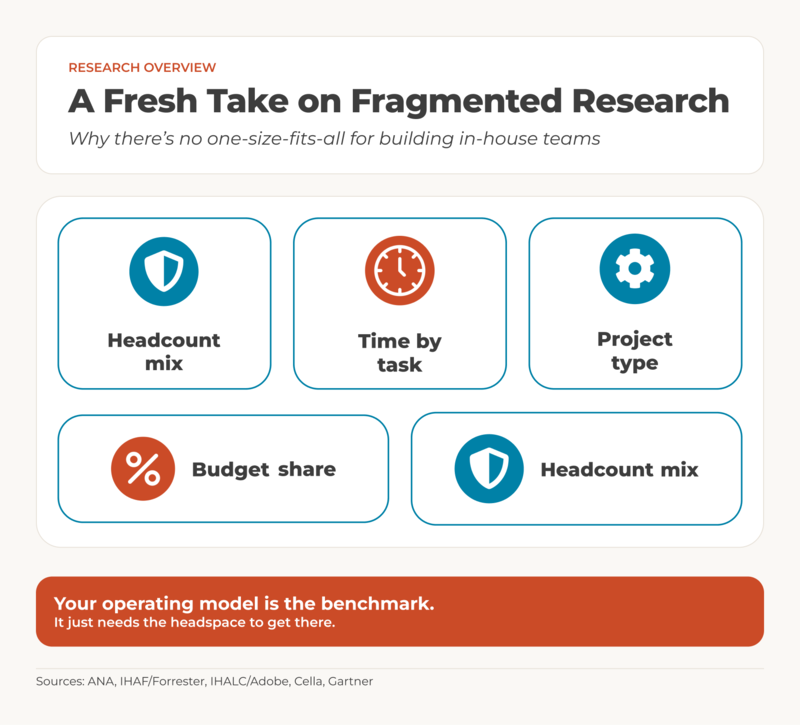
We went looking for one, for our clients and for ourselves. We work as embedded delivery teams inside in-house agencies, so the question of who carries which work is one we answer every day. We reviewed staffing research from IHAF and Forrester, the ANA, IHALC, Cella, Gartner, HBR Analytic Services, and others. Here's what we found, and what we didn't.

Is there a staffing benchmark for in-house agencies?

No. None of the major sources we reviewed publish a recommended split between full-time staff, production partners, and freelancers. Cella describes all three components and offers services for each, but it assigns no ratios. IHAF and IHALC both break down the types of work in-house agencies handle, from new creative to minor updates, but neither prescribes who should do it. Maybe it means there are just too many variables to derive a standard or a best-in-class scenario. Or possibly, it could be a result of nothing staying in place long enough to capture consistent benchmark data. 

How many brands run an in-house agency?

Every five years, the ANA surveys its brand marketers about their in-house agencies. In the 2023 edition, 82% of the 162 marketers who responded said their company has one, doubling the finding from 15 years prior. The ANA defines an in-house agency broadly: any department, group, or person handling work an external advertising or marketing communications agency would typically do.

Many of these teams work across borders. In IHAF's study, 55% of in-house agencies support global markets rather than the US alone.

In-house growth hasn't pushed external agencies out. In the ANA's survey, 92% of respondents also work with outside agencies, and for those companies, the in-house team handles an average of 61% of the work. Work also keeps moving inward: 65% had moved business from an external agency to their in-house team in the past three years.

How in-house agencies are staffed today

Even before the latest wave of budget pressure, restructuring, and AI-related workforce cuts, in-house agencies were already stretched.

In IHAF’s 2023 study, 57% of in-house agencies said they were not staffed to meet demand. Among that group, 69% cited capacity and headcount as the main reason, up from 63% in 2018.

That matters because in-house agencies are still built mostly on permanent staff. The ANA’s most recent figure, from 2018, found that full-time employees make up 79% of in-house agency staff. The same pattern holds outside the US: IHALC’s 2023 benchmarking of European brands found that 65% run a split of 70/30 or more in favor of permanent staff.

The broader operating environment has only tightened since then. Gartner’s 2026 CMO Spend Survey of 401 marketing leaders at large companies in North America and Europe found that the average marketing budget was 7.8% of company revenue, 18% lower than four years earlier. In that same survey, 56% of CMOs said they lack the budget to deliver their 2026 strategy, and 54% reported insufficient resources. Meanwhile, AI has become a leading stated reason for US job cuts: in the first half of 2026, employers attributed about 23% of announced cuts to AI, up from 5% across all of 2025.

Taken together, the staffing data and the broader budget data point in the same direction: the pressure on in-house teams has grown, not eased.

How traditional agencies separate idea development from production

For comparison, look at how standalone agencies handle the same tension.

Agencies traditionally handled three jobs under one roof: coming up with ideas, producing them, and placing media. Over the past decade and more, that bundle has come apart. Many advertisers decoupled production from their creative agencies, and agency holding companies built dedicated production businesses such as Hogarth and TAG Worldwide, covering everything from video and print to digital versioning and localization. Those production partners can take work from any source, whether an agency, an internal team, or a boutique.

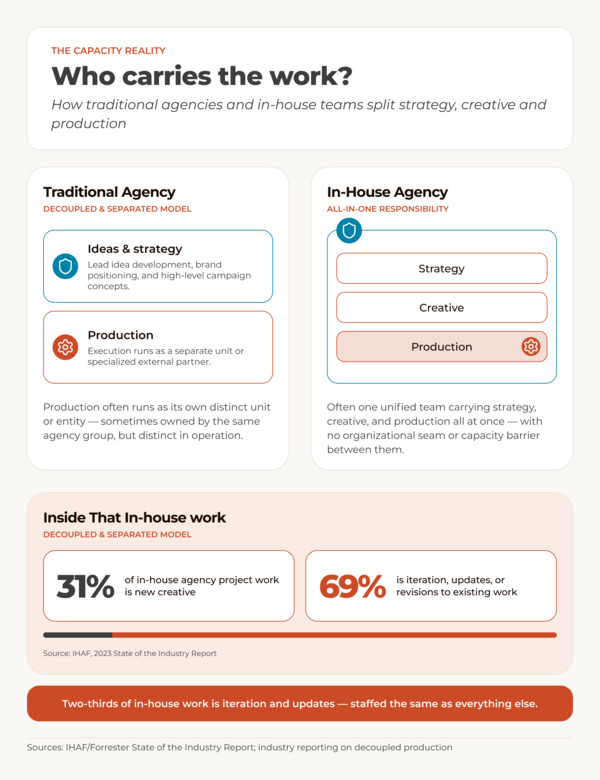
At many large agencies and agency groups, production runs as its own team or company, so the people shaping an idea usually are not the ones producing every version of it. The difference is not creative capability. It is where the seams sit. At an agency, creative and strategic thinking usually stay together as one function, separate from production. In-house teams more often carry strategy, creative, and production inside the same group.

In-house teams took on much of that work without inheriting the structure around it. One team often carries strategy, creative, and production while also answering to more of the business at once. Adobe’s research points to the strain that duality creates: 79% of agency creatives said they were very well aligned with their marketing teams, compared with 48% of in-house creatives. Adobe attributed the gap to in-house creatives facing more competing priorities and directives.

That raises a useful design question for in-house leaders: how do you get the same separation between idea and production without splitting up the team or handing the work to an outside agency? One answer is an embedded production layer that works inside the in-house team's workflow and standards.

Where in-house creative teams spend their time

IHAF's data shows where that combined load lands. In 2023, 31% of in-house agency project work was new creative. The rest built on work that already existed: 30% was creative iteration, 18% was major updates, and 20% was minor updates with no new creative thinking. In other words, about two-thirds of the work extends, adapts, or revises existing material.

Other research points the same way, with different numbers. IHALC's benchmarking of European in-house agencies measured time rather than project counts, and found that 45% of teams spend most of their time on adaptation work. The figures don't line up exactly because the studies measure different things. That's a useful reminder on its own: even well-run studies can't be lifted straight into your planning, because the way a benchmark is measured shapes what it tells you.

The work itself is necessary. The issue is where it lands. In a lean team, it often goes to the first person with a free hour, and that pulls people away from the brand-level work they know best.

Who carries the work — Option 2

The freelance layer is hard to reach and harder to manage

When capacity runs out, many teams turn outward. In IHAF's study, capacity limitations were the top reason internal clients outsource work, cited by 34% of respondents, up from 24% in 2018.

Managing that outside help well isn't simple. In a 2023 survey of 514 US business leaders by HBR Analytic Services and Fiverr, organizations estimated that freelancers handle about 20% of their work, but only 38% said they manage freelancers very effectively.

The HBR study covers all industries, not creative work specifically. Still, it's a reasonable signal. If organizations in general struggle to manage freelance talent well, creative teams are unlikely to find it easier, because brand knowledge takes time to build and can walk out the door when a contract ends.

AI use has moved ahead of AI policy in creative teams

AI is already saving creative teams real time. In a 2026 survey of more than 300 creative professionals, 96% reported saving more than 5 hours a week with AI tools, and more than half reported saving over 10 hours.

The same survey shows the rules haven't kept pace. 96% of respondents said their organizations formally restrict AI use, and the same share admitted using unapproved AI tools anyway. 73% named copyright as a concern with AI-generated content, and 66% named data privacy and security. Leadership readiness is lagging too: in Gartner's 2026 survey, CMOs allocated an average of 15.3% of their marketing budgets to AI, but only 30% said they're ready to scale AI capabilities.

Concern about privacy also rises with company size. It was 83% at companies with more than 500 employees, compared with 35% among freelancers. For large organizations, that means the people most often brought in to absorb volume may be the least likely to share the company's caution.

Creative work sits near the center of this. In UpGuard's research, marketing and sales teams reported using unapproved AI more than operations and finance teams did. We've written more about shadow AI in the enterprise (read more here). CEO Joe Edwards covers how AI expectations are adding to the demand on in-house teams in Drowning in Success.

Who carries the work — Option 3

Build your own staffing benchmark

Since there's no industry standard, and the studies that exist measure different things, the most reliable benchmark is your own team's numbers. Four are worth pulling this quarter:

  • Adaptation share: What portion of last month's requests were iterations, updates, or versions of existing work?
  • Team time on production: How many hours did your in-house team spend on that work instead of brand-level projects, new campaign concepting and planning?
  • Flex response time: How long does it take to get qualified outside help working on a real request?
  • Approved versus actual tools: Which AI tools are approved, and which is your team actually using to hit deadlines?

In our work alongside in-house teams, numbers like these have told us more than any industry ratio. They show where the work is landing, not just who's on the payroll. In our embedded work, teams get the most from these numbers when they use them to decide what stays with the core team and what moves to a steady production layer.

Once you have them, the next question is where each kind of work should land. My colleague Jim takes that up in How to Give Creative Leaders Their Headspace Back.

Considering an embedded team alongside your in-house agency? Download the overview to learn more about our services. 

Sources: IHAF, The Truth About In-House Agencies: 2023 State of the Industry Report (with Forrester Research); ANA, The Continued Rise of the In-House Agency (2018, 2023); IHALC/Adobe In-House Agency Benchmarking Survey (2023); Gartner 2026 CMO Spend Survey; Challenger, Gray & Christmas Job Cut Reports (2026); Adobe, Future of Creative Experiences; HBR Analytic Services/Fiverr (2023); Santa Cruz Software creative professionals survey (2026); UpGuard, State of Shadow AI (2025).


Frequently asked questions


What percentage of in-house agencies are adequately staffed?

In IHAF's 2023 State of the Industry study, conducted with Forrester Research, 39% of in-house agencies said they are staffed to meet demand and 57% said they are not. Most of those citing understaffing named capacity and headcount as the main reason. More recent data suggests the pressure has grown: in Gartner's 2026 CMO Spend Survey, 54% of CMOs reported insufficient resources.

Is there a staffing benchmark or recommended ratio for in-house agencies?

No major research body publishes one. IHAF, the ANA, Cella, IHALC, and the major analyst firms describe staffing models and types of work, but none assign a standard split.

How do traditional agencies handle production differently from in-house teams?

At many large agencies and agency groups, production runs as its own team or company, and many advertisers have decoupled production from their creative agencies. In-house teams more often carry strategy, creative, and production within one team.

Does Tonic3 offer staffing services for in-house agencies?

No. Tonic3 works as an embedded delivery partner, providing a managed production team that works inside an in-house agency's existing workflow and standards — not staffing placements or freelance sourcing. 


Driving Efficiency with Agentic Process Automation: Insights and Strategies

Driving Efficiency with Agentic Process Automation: Insights and Strategies

Discover how agentic process automation revolutionizes business efficiency, adaptability, and decision-making, and learn strategic steps CTOs should...

Read More
How to Tell If Your In-house Agency Has a Headcount Problem, or a Process Problem

How to Tell If Your In-house Agency Has a Headcount Problem, or a Process Problem

Is your in-house creative team overwhelmed? Learn how to identify whether your challenges stem from a headcount issue or a broken process before...

Read More
Scaling Your Next Project: 5 Tips for Effective Resource Planning

Scaling Your Next Project: 5 Tips for Effective Resource Planning

Effective resource planning ensures your project reaches its peak. Learn how Tonic3 equips you with the right tools, teams, and strategies for...

Read More