1 min read
Veeva and Salesforce: Differences and Similarities
Yes, we’ve implemented both Veeva and Salesforce for major Pharma clients (like Novartis). From that work, we learned the software doesn't matter if...

Tonic3 develops and executes strategies that drive profit through Digital Transformation. Practically that means we are built to help clients hone the right strategy, implement the right technology, and build the right long-term capabilities to deliver lasting transformation.
Industries
We believe that effective technology helps people succeed in their daily lives. So we help our clients engineer useful technology for their clients, partners, and employees. That translates to every major industry, but over the years we’ve developed several core areas of expertise.
2 min read
Marina Uchoa
:
Apr 8, 2026 6:59:42 PM
The data is in, and it’s a contradiction that should keep every Director up at night.
On one hand, we’re witnessing SaaSmageddon: 35% of teams are already replacing SaaS seats with custom AI builds. On the other hand, Gartner predicts a staggering 60% abandonment rate for GenAI projects through 2026.
We are killing off the old vendors to build our own tools—only to abandon those tools before they ever reach the finish line.
As a leader caught between the pressure to innovate and the mounting risk of "Shadow AI," you have to ask: Are we building a future-proof ecosystem, or just a pile of expensive experiments?
What comes next for Tech Leaders after SaaSmageddon?
There is a massive capability gap between "vibe-coding" a tool and shipping enterprise software. It’s easy to get a prototype to 90% functionality. But who is on call at 2:00 AM when those "vibes" hit a logical edge case or a data residency violation?
Enterprise-grade isn't about the first 90% of the build; it’s about the final 10% that ensures security, scalability, and confidence to that that final solution will be widely adopted to have an impact on the business objective.
We know that over half of employees admit to using unauthorized AI at work. They aren't trying to be "rogue"—they are just trying to be productive. When company-provided tools are painfully clunky or incomplete, compare to what they can find via a niche agentic "teammate", they will choose the path of least resistance every time. And in many cases, believe they are doing good for the company by being more efficient.
This brings us to a critical crossroads for a CIO's 2026 roadmap. As we see a "shut it down" undercurrent growing within governance circles, we have to pose the harder questions:
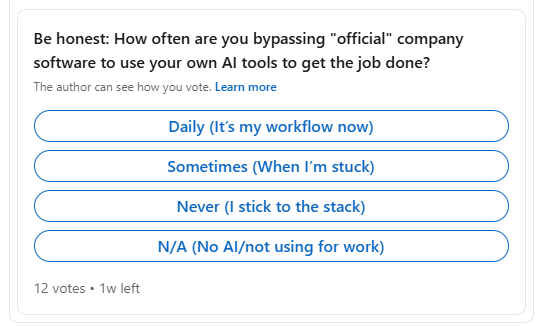
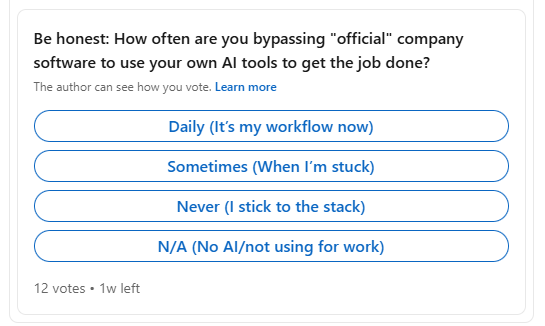
We’re tracking the shift from "SaaS-reliant" to "Custom-built." We want to know how your organization is navigating this era of Shadow AI. Click to cast your vote.
CAST YOUR VOTE BELOW:
What % of your team do you suspect is "Guilty" of BYOAI (Bring Your Own AI)?

Widespread ROI doesn't come from the newest model; it comes from widespread adoption. And adoption comes from usability.
You don’t need to stop building; you need to stop building on shaky ground. The solution isn't to fight the battle of locking everything down—it’s to create internal tools and governance processes that people actually want to use.
When you hit that 90% mark and find yourself standing at the base of the enterprise-grade cliff, don't rely on vibes. Seek the architecture that ensures your implementation actually sticks.
Feel like discussing this further? Hop into the Linkedin chat with CEO Joe Edwards.
1 min read
Yes, we’ve implemented both Veeva and Salesforce for major Pharma clients (like Novartis). From that work, we learned the software doesn't matter if...
Mid-size businesses are under immense pressure to streamline operations, but traditional code-first frameworks often create more bottlenecks than...