
.jpg) Ale Sanchez
Ale Sanchez
Boosting Productivity and Efficiency with Human-Centric AI Design
 Tonic3 : Feb 13, 2026, 12:11:28 PM
Learn how Design Thinking, human-centered AI, and HITL design drive Gen AI adoption, trusted AI UX, and measurable enterprise ROI.
The numbers tell a story that should stop every IT leader in their tracks.
Two major research efforts published in 2026 — WalkMe's State of Digital Adoption, surveying 3,750 enterprise executives and workers, and Writer's AI Adoption in the Enterprise, surveying 2,400 C-suite leaders and employees — arrived at the same uncomfortable conclusion: organizations are losing the AI adoption battle not because their technology is wrong, but because they never designed for the people who have to use it.
Teams are losing 51 full working days a year to tool friction. Not distraction. Not disengagement. The tools bought to help them. Meanwhile, 97% of employees say they personally benefit from AI. Only 23% of companies are seeing significant organizational ROI.
Read that again. The individuals are winning. The organizations are losing.
That gap has a name. And it isn't a technology problem.
One of the most consistent findings across enterprise AI research is that the most technically advanced solution rarely wins on merit alone. What wins is the solution people can actually use.
The original breakthrough of conversational AI wasn't raw capability — it was interface. For the first time, people could interact with a complex AI system in a simple, natural way. That single design decision drove adoption at a scale no technical specification could have predicted. The lesson still applies today: a great user experience is often more critical than the underlying technology itself.
The inverse is equally true. When AI systems are optimized for performance metrics without accounting for how they feel to use — when they lose the warmth, the intuitiveness, the sense of being understood — adoption collapses. Intelligence without experience isn't adoption. It's abandonment.
This is why the WalkMe finding is so significant. A full working day, every week, lost to friction. That isn't a product failure. It's a human-centric AI design failure. And it's a structural one — meaning it compounds over time, quietly eroding whatever ROI the technology was supposed to deliver.
When AI adoption stalls inside organizations, the instinct is to blame resistance. But resistance to AI is rarely irrational. It's often a completely logical response to how the rollout was handled.
The Writer 2026 report makes this explicit in a way that should reshape how any leader thinks about implementation: 54% of C-suite executives say adopting AI is tearing their company apart. 56% report power struggles and disruption. And 29% of employees — rising to 44% among Gen Z — admit they have actively worked against their company's AI rollout in some form.
This is not people being difficult or uninformed. It is a reaction to a system that was forced on them instead of built with them. Employees and managers who see AI as a risk to the roles below them — and eventually to their own — are reasonable to be careful. They are reacting to a real issue that leaders have mostly not addressed openly.
For AI to work inside a company, the rollout must confront these fears directly. Not with vague reassurance or internal campaigns, but with concrete design choices that make each person’s role clearer, more valuable, and more visible — instead of replaceable.
One of the most persistent myths in enterprise technology is that adoption failures are primarily a change management challenge. Train people better. Communicate more. Run more workshops.
But the WalkMe data points to something more structural: when technology isn't designed to fit how people actually work, they reject it — regardless of long-term organizational benefit. The disruption to daily workflow isn't a perception problem. It's a design problem.
This is where Intelligent Process Engineering earns its place — designing workflows around how people actually work, rather than asking people to restructure around the technology.
The organizations closing the adoption gap — the 23% seeing real ROI in the Writer data — aren't just better at managing change. They're building AI that fits into how their people already work. If you want to understand what that friction actually costs before you fix it, the math on software sprawl is more alarming than most leaders expect.
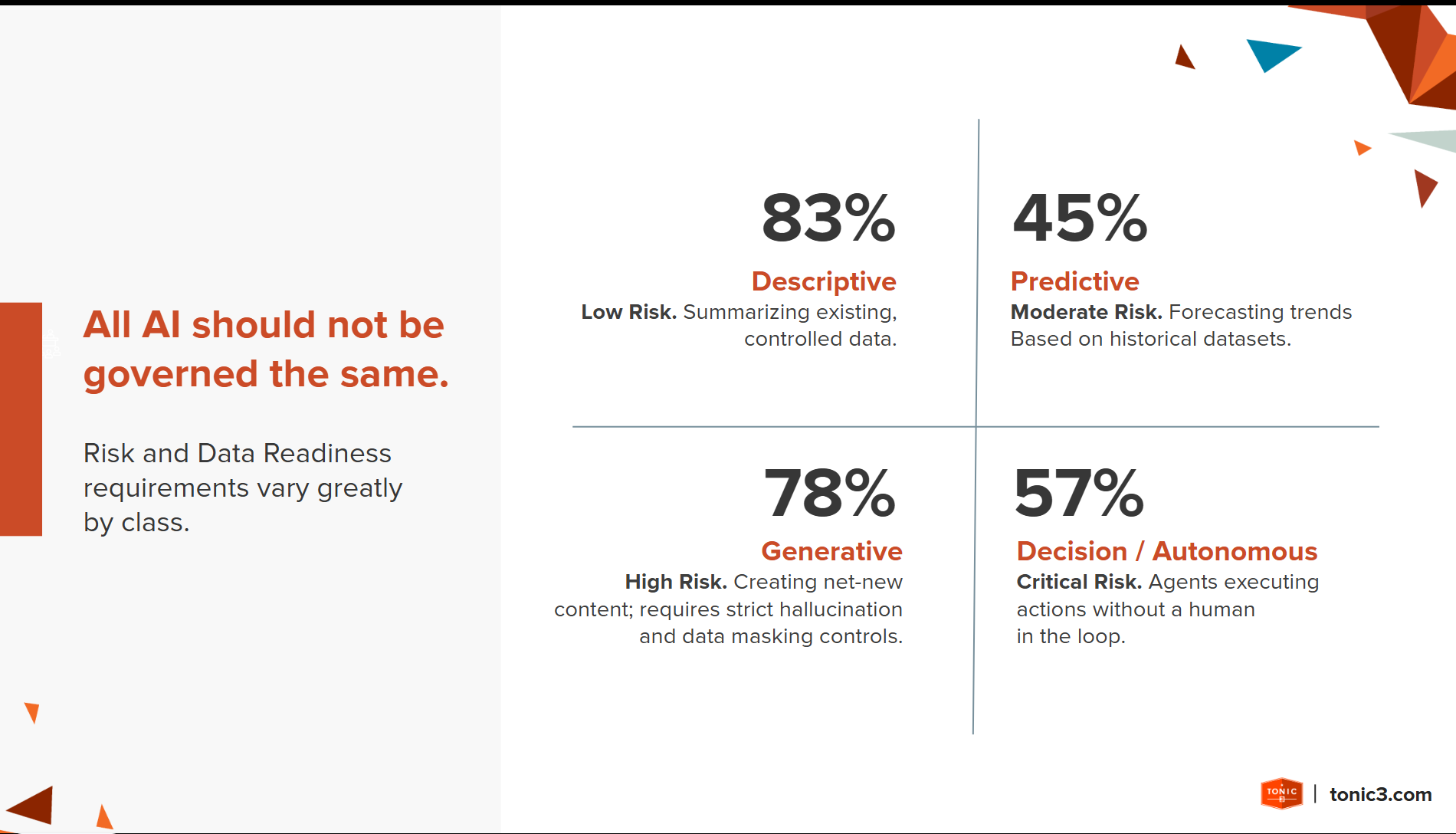
There's one more layer to the adoption problem that rarely gets discussed: organizations are treating all AI as a single governance challenge, when the risk profile of each type of AI is categorically different.
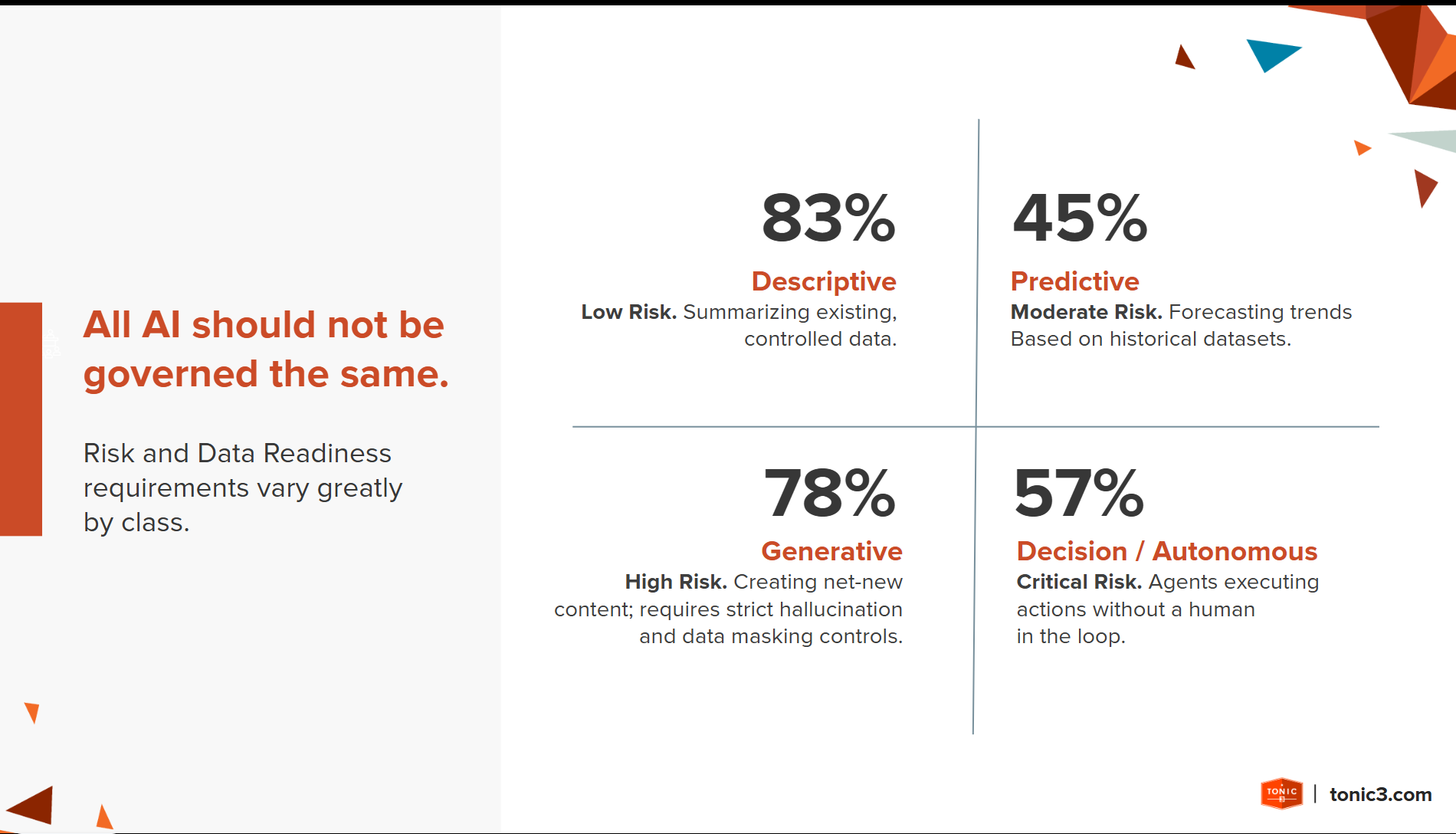
A descriptive AI summarizing existing, controlled data carries low risk. A predictive model forecasting trends from historical datasets carries moderate risk. A generative AI creating net-new content requires strict hallucination and data masking controls. And a decision or autonomous AI — agents executing actions without a human in the loop — carries critical risk.
Deploying all four under the same governance framework isn't just inefficient. It's a structural mismatch that either over-controls the low-risk applications (slowing adoption) or under-controls the high-risk ones (creating liability). Both outcomes produce the same result: less value from more investment.
This is the piece that the 2026 data exposes most clearly. The gap between AI investment and AI ROI isn't random. It's concentrated in organizations that haven't yet built the infrastructure to govern different types of AI appropriately. Knowing which decisions need a human in the loop, which outputs need validation, and which processes can safely run with greater autonomy — that's what Enterprise AI Strategy is actually for.
Ultimately, the disconnect between the promise of AI and its slow organizational adoption comes down to one truth: we are still figuring out how to build technology that works with us, not just for us.
The next major breakthrough won't be a more powerful model. It will be organizations that figure out how to deploy AI in a way that respects human needs, addresses real fears, fits existing workflows, and governs different risk levels appropriately. Not as an afterthought. As the primary design constraint.
This is what we mean by the New Design Imperative. Human-centered design is no longer optional in AI implementation — it is the deciding factor between adoption and failure. The 2026 data confirms what we've believed for a while: the organizations pulling ahead aren't the ones with the biggest AI budgets. They're the ones that designed for the humans first.
Adoption problems usually point to workflow friction, weak governance, or poor human-in-the-loop design. See how leading teams are addressing those issues inside real AI workflows. See it in practice.
The slow adoption of AI isn't a technology issue — it's a people issue. And it's a design issue. Success starts with putting humans at the center of every decision: how the AI is introduced, how it fits into existing workflows, how different risk types are governed, and how the people using it are supported through the transition.
User-centered design isn't optional. AI is just a tool. The real goal is adoption at scale — and that only happens when you design for the people who will actually use it, not the people who approved the budget.
If you want AI that actually delivers for your business, you need a partner who sees beyond the technology. A team focused on your business problems and the people involved — from the first strategy session to full-scale adoption.
Let's have a conversation about building AI your team will actually use.
Sources: WalkMe State of Digital Adoption 2026 · Writer AI Adoption in the Enterprise 2026
 Tonic3 : Feb 13, 2026, 12:11:28 PM
Learn how Design Thinking, human-centered AI, and HITL design drive Gen AI adoption, trusted AI UX, and measurable enterprise ROI.
-4.png) Tonic3 : Feb 2, 2026, 1:10:44 PM
Tonic3 : Feb 2, 2026, 1:10:44 PM
Enhance strategic planning with AI. Learn how AI-driven insights improve decision-making, efficiency, and agility while addressing challenges in data...

 Marina Uchoa : Mar 17, 2026, 5:20:17 PM
9 UX shifts redefining product and design strategy in 2026 — from agentic interfaces to trust architecture — with practical guidance for UX leaders...