How CIOs Turn AI Spending Into Business Impact: Adoption, Governance, and ROI
You already know AI adoption is broken. Here is what you actually do about it.
Tonic3 develops and executes strategies that drive profit through Digital Transformation. Practically that means we are built to help clients hone the right strategy, implement the right technology, and build the right long-term capabilities to deliver lasting transformation.
Industries
We believe that effective technology helps people succeed in their daily lives. So we help our clients engineer useful technology for their clients, partners, and employees. That translates to every major industry, but over the years we’ve developed several core areas of expertise.
5 min read
Pablo Sigler
:
Jul 17, 2026 4:02:22 PM
When global enterprises roll out center-led artificial intelligence and IT strategies, the promise is usually the same: universal efficiency, standardized governance, and wide-reaching economies of scale.
But as someone who works at the intersection of US and Latin American markets every day, I see a recurring bottleneck. Global IT and AI teams are often strong at broad-stroke automation and platform design, yet they can run into friction when those systems meet regional operating realities.
At Tonic3, we are partnering with major global enterprises across industries ranging from mass media and entertainment to global biotechnology to deploy localized AI proof of concepts (PoCs). What we continue to see is more specific than a universal rule: programs lose momentum and cost savings when systems orchestration does not account for local context.
Here is where enterprise AI budgets slow down, where the blind spots tend to appear, and how a more localized approach to workflow automation can improve measurable business outcomes.
A central IT team in New York or London can design a strong global ERP integration. However, those teams do not always have visibility into the hyper-specific, document-heavy workflows that happen at the regional level.
We see this friction manifesting consistently across three areas:
When global tools are deployed without enough regional workflow design, local input, and domain knowledge from existing human-centered processes, performance can drop quickly. The issue is not always the AI model itself. More often, the gap sits in the surrounding systems orchestration: how documents are routed, how exceptions are handled, how country-specific rules are interpreted, and how local teams stay involved when language, HR policies, tax requirements, or government regulations shape the process.
The result is slower throughput, more manual review, and lower ROI than leaders expected.
To create measurable business outcomes, enterprises need to move from a rigid 'one-size-fits-all' framework to a more adaptive operating model that considers localized requirements and constraints.
Through regional AI PoCs, Tonic3 helps global brands build intelligent systems tailored to regional realities. In some cases, that includes AI-powered classification or extraction. In others, it means enterprise workflow automation tools that is not exclusively AI-driven, but still improves operational efficiency by structuring intake, routing work correctly, and reducing avoidable manual effort.
The most effective localized layer is usually built with local input and domain knowledge from the people-centered processes already in place. That can mean language-specific handling, country-level policy logic, HR requirements, billing rules, or government compliance parameters that shape how work actually moves.
However, automation without guardrails creates risk. That is why Human-in-the-Loop orchestration matters at critical decision points.
By keeping local operational experts in the loop, the system can handle much of the sorting, categorization, and data extraction, while human reviewers validate anomalies such as an unfamiliar invoice layout, a reimbursement edge case, or a document that falls outside standard policy logic. This approach helps maintain trust, supports governance, and improves processing speed without removing human judgment from the process.
This regional breakdown is exactly where budget pressure starts to show. Global programs are usually funded on the assumption that one standardized system will scale efficiently across markets. But when that system runs into country-specific documents, language differences, HR policies, tax rules, or regulatory requirements it was not designed to handle, the enterprise absorbs a second layer of cost: manual workarounds, local exceptions, delayed rollout, added compliance review, and rework.
In other words, there is a real cost to not considering the manual, local workarounds unique to each region or country. When the roll out does not resolve the underlying local operational pain points, it is also unlikely to deliver the ROI leaders expected. Instead, investment continues while business impact is reduced by exception handling, slower adoption, and fragmented execution.
That is why regional workflow automation matters from a budget perspective. A localized approach helps enterprises protect the original investment by addressing the highest-friction processes first, where manual effort, processing delays, and compliance risk are most likely to erode ROI. Instead of expanding spend on broad transformation programs without proving operational impact, leaders can use focused regional PoCs to show where orchestrated workflows, local domain input, and Human-in-the-Loop review create measurable business outcomes before scaling further.
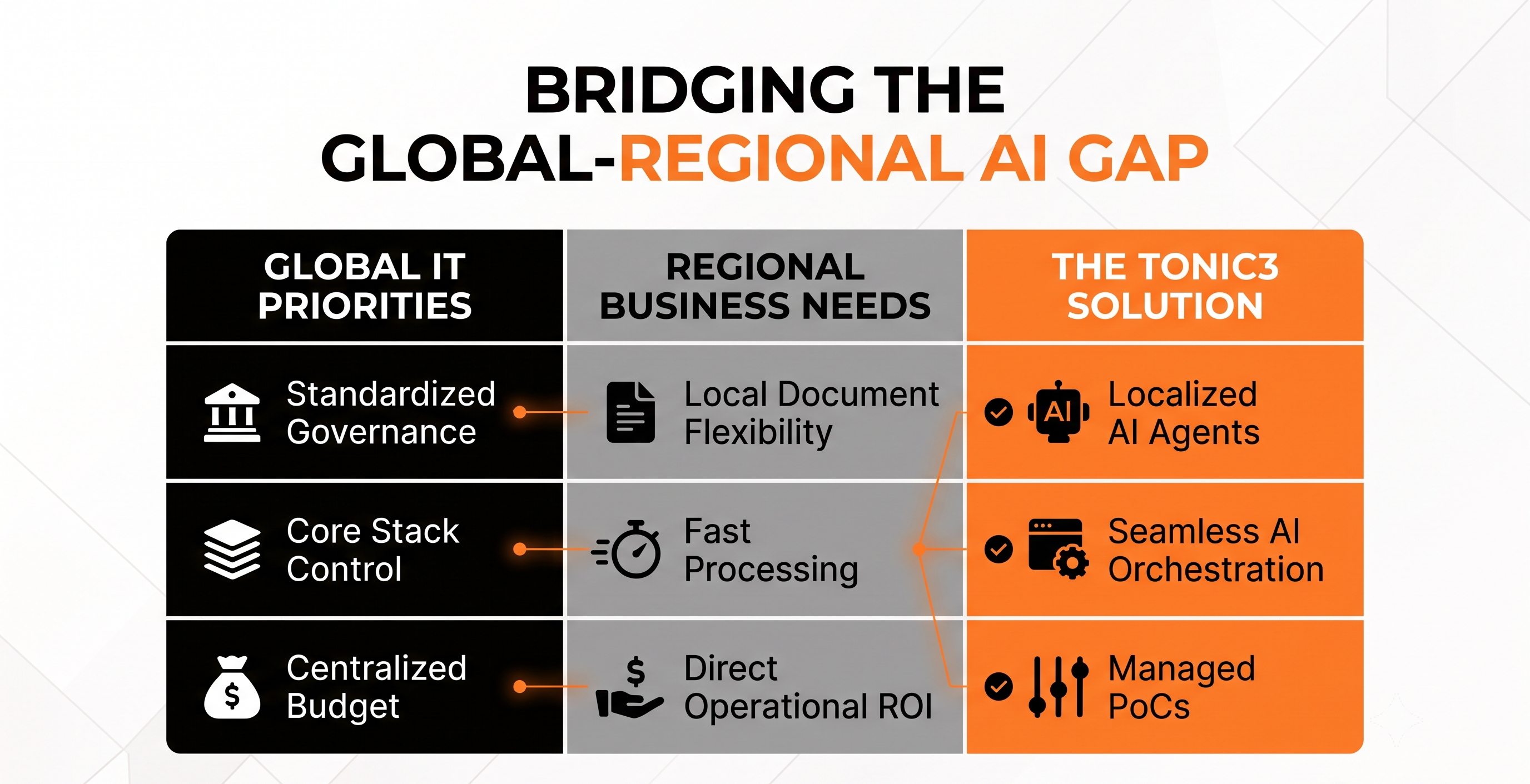
For performance-driven leaders, the challenge is not just technical delivery. It is alignment. Budgets tend to stall when central IT, regional operators, and business stakeholders are optimizing for different outcomes. Central IT may prioritize governance, security, and architectural consistency, while regional teams need faster processing, local document flexibility, and fewer operational bottlenecks.
| Global IT Priorities | Regional Business Needs | The Tonic3 Approach (Bridging the Gap) |
|---|---|---|
|
Universal Compliance & Security Standardized Core Tech Stack Centralized Budget Control |
Local Document Flexibility High Processing Speed Reduced Manual Labor Costs |
Localized AI Agents inside a Secure Global Framework API-driven AI Orchestration across systems and worfklows Managed PoCs to demonstrate fast, measurable ROI |
By acting as a bridge with a strong presence in both the US and Latin America, Tonic3 understands the governance requirements of a global executive team while also bringing the regional context needed to design for local operating realities. That combination helps enterprises build orchestrated systems that fit real workflows instead of forcing regional teams into generic process assumptions.
If your global AI initiatives are facing friction at the regional level, you are not alone. The answer is not to abandon the global strategy. It is to strengthen it with localized orchestration, local domain input, and workflow design that reflects how work actually happens.
Real progress happens when central strategy meets local execution. True innovation happens when central strategy meets local execution. By building regional PoCs that tackle the high-volume, manual workflows of your local offices—backed by strict budget guardrails and human-in-the-loop safety—you can finally turn your enterprise AI spending into tangible business impact.
While global IT automation focuses on core enterprise-wide software consistency (like deploying a single ERP system worldwide), regional workflow automation solves localized, high-friction operational tasks. These include handling region-specific invoice layouts, local employee reimbursement regulations, and country-level compliance paperwork that centralized, center-led AI tools are too generic to understand.
Global AI adoption strategies often fail regionally because central models lack the local training data required to process hyper-specific documents. For instance, an AI trained on US corporate structures cannot naturally interpret a Latin American Nota Fiscal or specific regional patient support program documents, leading to high error rates and forcing local teams back to slow, manual data entry.
Human-in-the-Loop (HITL) orchestration places human operational experts at critical validation check points within an automated system. Instead of relying completely on AI, the system automates 90% of the repetitive document extraction and flags complex regional anomalies or unstructured data for human review. This balance guarantees 100% compliance, controls infrastructure costs, and prevents unexpected operational errors.
A nearshore digital agency with a dual presence in both the US and Latin America bridges the gap between global governance and regional execution. They understand the strict data privacy, budget guardrails, and compliance standards required by US enterprise CIOs, while possessing the local cultural and technical expertise to code for the unique document variations and workflows found in regional LATAM offices.
You already know AI adoption is broken. Here is what you actually do about it.
For Change Champions and Performance Drivers, Azure AI is not just a technological advancement; it's a strategic asset that can transform your...
AI is not just a buzzword; it is a tool that can significantly enhance your company's strategic planning process. In this article, we will explore...